With another holiday-shortened week, the economic calendar was light. One interesting data point was Tuesday, when 3rd quarter gross-domestic-product (GDP) was released. 3rd quarter GDP came in at 4.3%, much better than the 3.2% most economists had expected. We have not seen a 4-handle on a GDP print since the 3rd quarter of 2023. A quick refresher, 70% of the U.S. economy is driven by the consumer. If consumers remain resilient, the economy will do the same. U.S. Economy Grew 4.3% in Third Quarter, GDP Report Shows - WSJ . While GDP is backward-looking and doesn’t give us keen insight into the health of the economy as we go into 2026, the significance of a 4%+ GDP release is worth noting.
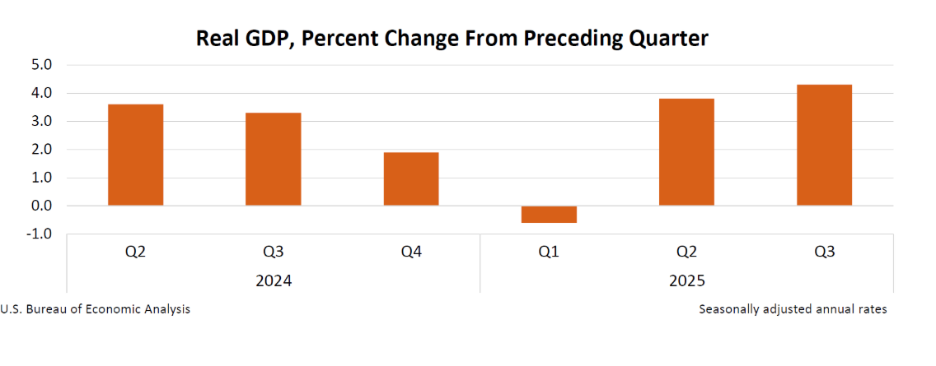
With economic data remaining resilient, and stock and bond markets, not just here in the U.S. but globally, delivering above average returns in 2025 (with the correlation of economic health and market performance not always positive) – why are most Americans’ views on the overall health of the economy and their own personal financial situation so pessimistic? This question has been discussed at great length this year and will more than likely continue into 2026. The two best explanations I can give: 1) discussed in a prior newsletter The K-Shaped Economy: The Split Reality of 2025 2) the ongoing divergence between “soft” vs. “hard” economic data – surveys/sentiment indicators vs. retail sales/GDP/employment etc. These two themes will be worth watching as the calendar flips to a new year.
Financial Planning Corner
In a world of instant gratification, one of the ultimate acts of delayed gratification is saving for retirement. Just like with most things in life, balance is usually the most prudent choice. Enjoying the fruits (some) of your labor now, while still saving for future. However, the shockingly low retirement savings by age cohort is concerning. The Average Retirement Savings by Age | Kiplinger . The lack of retirement savings leads to heightened levels of stress, anxiety, and overall unhappiness. Potential solution:
Australia’s Superannuation: Could It Work in the U.S.?
There has been an uptick in discussion from the White House regarding ways to “fix” the lack of retirement security American’s feel. With the significant decrease in the number of employers offering defined-benefit (pension) plans – which guarantees a retirement benefit for workers based on years of service and earnings (with the investment risk falling on the employer) - the responsibility of saving for retirement (and investment risk) has almost entirely fell on the employee. As adults, you must assume some level of responsibility for your future, but what if there was a better way forward? A way in which some individual responsibility is maintained, but there was more help from your employer? Turn your focus to the land down under – In Australia’s Superannuation program, the employer is obligated to contribute 12% of an employee’s salary into a retirement (super) account, then the employee directs (both employer and employee contributions) to a super fund. What is superannuation - Moneysmart.gov.au
Affordable Care Act (ACA) – Enhanced Premium Tax Credits Expiration
The continued inaction of Congress regarding solutions to the expiration of the enhanced premium tax credits leaves millions of Americans in limbo on potential healthcare costs for 2026 (another potential reason for the heightened level of pessimism). I don’t think it’s a stretch to say that our healthcare system is broken. As premiums dramatically increase for millions, inaction will no longer be tolerated. Hopefully, in the next month or two, more clarity will be gained. ACA Marketplace Premium Payments Would More than Double on Average Next Year if Enhanced Premium Tax Credits Expire | KFF
Charitable Giving in 2026
In this season of giving, one feature of the recently passed tax legislation – that will become effective in 2026, allows non-itemizers to take a deduction of up to $1,000 for contributions made to qualified charitable organizations. While one doesn’t give for the tax deduction, if you normally give and take the standard deduction, you will get an added benefit. Changes to Charitable Giving Under the One Big Beautiful Bill Act
Quick Hits:
- As an avid college football fan, I’m excited to watch the college football playoff quarterfinals – you won’t see Tennessee unfortunately – happening on New Year’s Eve and New Year’s Day 2025-26 College Football Playoff Bracket - College Football Playoff
- Still trying to figure out New Year’s Eve plans? A few ideas for those in and around Maine: Celebrating New Year's Eve in Maine: 7 Ideas to Plan Your Trip | Stage Neck Inn
- A new year comes New Year’s resolutions – consistency and discipline are key in almost every facet of life (first to admit several of my resolutions that lasted only a month or two) - Why New Year’s Resolutions So Often Fail And What Works Instead
- Wanting to travel on a budget in 2026? 20 Best Affordable Vacations in the U.S. for 2026 | U.S. News Travel
Embracing Change
I recently read “The Greatness Mindset: How to Unlock the Power of Your Mind and Live Your Best Life Today” by Lewis Howe’s (a mouthful, but worth a read). The part that resonated most with me was regarding the acceptance of the “status quo,” which doesn’t lead you to becoming the best version of yourself. Change and willingness to look at things differently often translates into growth. Whether it’s a change in jobs, homes, friends, or yes, even tradition – fosters personal development. Doing things that are comfortable and familiar doesn’t push you. While I broke tradition this year (for the first time, I’m not with my immediate family for Christmas), it presents an opportunity to embrace change and be grateful for some extended family (that live in MA), who have welcomed me at their table - I view it as a change in tradition (not necessarily replacing one😊).
Quote: “The root of joy is gratefulness...It is not joy that makes us grateful; it is gratitude that makes us joyful.”- Brother David Steindle-Rast
Happy holidays from RSWA. We hope you enjoy time with loved ones and create many memories.
Thank you for reading RSWA Financial Advisor Insights! We welcome feedback, and please forward this to a friend! Be well, take care, and stay safe!