Kevin Warsh was nominated by President Trump to become the next chair of the Federal Reserve, replacing Jerome Powell, whose term ends in May. Warsh served on the Fed Board of Governors from 2006 to 2011, so he is considered a conservative, establishment pick that markets can trust. Warsh is an advocate of lower government intervention in markets, disagreeing with the Federal Reserve’s increase in its balance sheet through quantitative easing. On policy, Warsh has long been considered an interest rate hawk, advocating for higher interest rates to prevent inflation, but shifted his view in November to the idea that lower interest rates should be the Fed’s approach. Overall, the Federal Reserve is considered an institution built on consensus with a board of governors, who have equal votes on interest rates and policy. The chair has influence but will need to convince other members to vote alongside any initiatives. What economic experts think about Trump's choice of Kevin Warsh for Fed chair | PBS News
That is also to say, Warsh will need to be confirmed in the Senate as chair. Republican Senator Thom Tillis, who serves on the Senate Banking Committee, has promised to block all appointments to the Federal Reserve board based on the investigations into Federal Reserve chair Jerome Powell and member Lisa Cook. Tillis feels the investigations impact the independence of the Federal Reserve: Warsh nomination: Tillis doubles down on blockade | CNBC
Precious Metal Volatility: Gold and silver prices rose in 2025, posting significant gains for investors. Investors saw the same results in 2026, until January 30th, when silver prices dropped over 27%, and gold dropped over 9% in one day. Into this week, the commodities are still trading off those highs in the price of each:
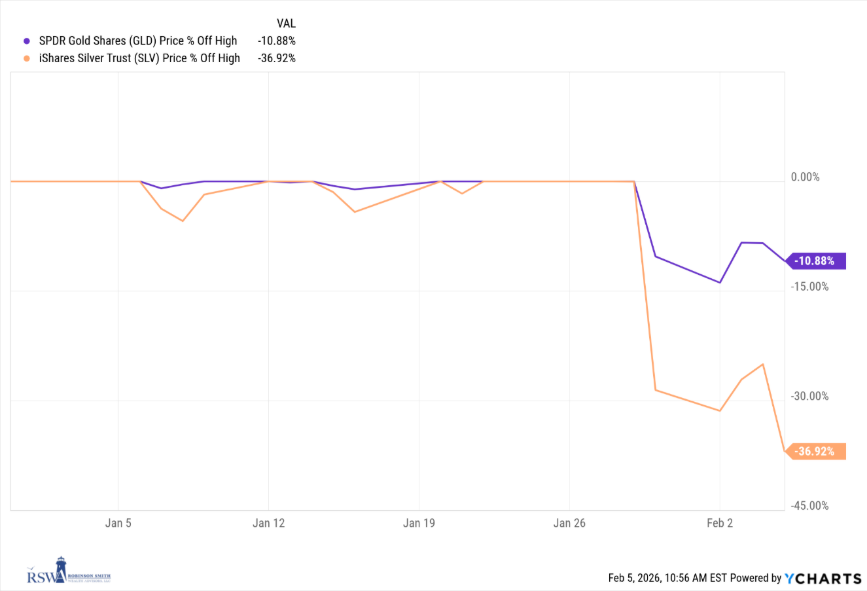
There have been several factors investors point to for the rise in commodity prices. We go through why they may not actually be the cause in the rise of metal prices:
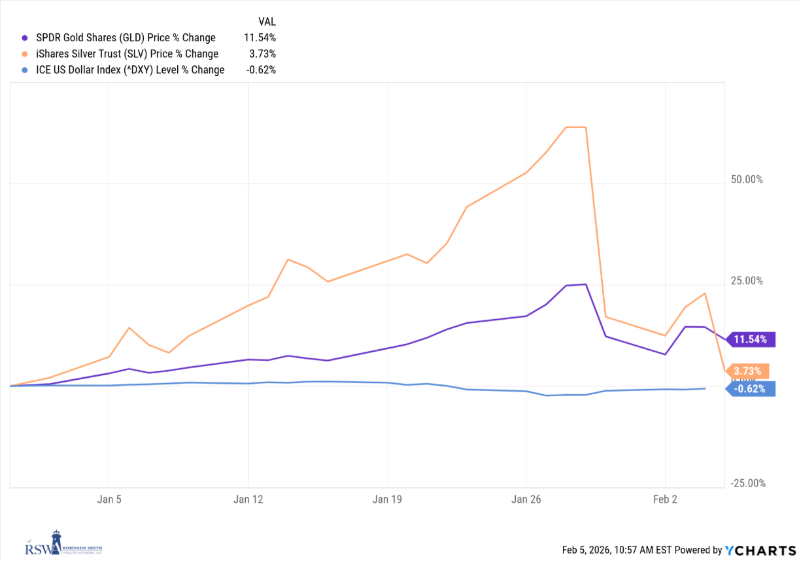
- Investors are seeking a dollar alternative: Central banks have stockpiled some gold vs. dollars to avoid the pain of any U.S. sanction: The recent trading in gold has been through ETFs, suggesting private investors are the cause. If it were a dollar alternative trade, metal prices would be rising while the dollar falls, but the dollar is only down 1% year to date and the three have not moved in sync with each other:
- Dollar Debasement Trade: Investors were worried about the next bout of inflation, due to government stimulus and the weakening dollar. Some see the nomination of Warsh to the Federal Reserve as quashing those fears and initiating the sell-off, as Warsh will be a steadier chair than other candidates. The issue with the debasement trade idea is that the bond market has not reacted to inflation fears, and long-term inflation expectations are lower than the beginning of 2025.
- Global Boom Igniting Inflation: Countries are all engaging in stimulus, which will result in higher inflation everywhere. That does not hold much water either, where the reason the Euro rose last year was because of planned stimulus. Japan and the United States are engaging in stimulus, too, but their currencies fell in line with each other. If investors were worried, they would be selling the stimulating currencies and buying gold, pushing currencies lower and gold higher, but that is not what we are seeing.
- Russian aluminum makes up 58% of the supply on the LME exchange and cannot be imported to the U.S. due to sanctions.
- Demand in Europe has increased, and Canada has diverted shipments there.
- Aluminum requires a lot of electricity to produce, and facilities have gone offline due to rising costs. Many regions are at full production capacity.
- A chart on the annual working hours per worker by country, since 1870.
- Catherine Ohara’s Tribute At The Westminster Dog Show | Buzzfeed
- Dark matter in space show evidence of gravity: NASA Reveals New Details About Dark Matter’s Influence on Universe | NASA
- An interesting database that maps out invasive plants, wildlife, and insects (I am fighting back bittersweet at home): EDDMapS
The arguments for why the price of precious metals are rising carry a little truth on their face, but when you examine further, it doesn’t seem to hold up when we look at the secondary or tertiary effects on other asset prices. What we do see is that owning gold and silver certainly increases an investor’s volatility. An Investor’s Guide to the Boom (and Bust) in Gold and Silver | WSJ
Another Metal Rising: Although less precious in name and connation, aluminum is an important metal in a variety of industries. Prices in the United States are trading at a 68% premium to the London Metal Exchange (LME), primarily due to President Trump imposing tariffs of 50%, but the metal is trading another $560 above the tariff premium, due to a variety of factors. In the U.S., aluminum is trading at over $5,000/ton and on the LME at $3,000/ton. One would think that traders would simply buy aluminum on the LME, ship it to the U.S., and sell it here to realize the premium (arbitrage in finance terms). The problem is that there is a lack of aluminum supply for a few different reasons:
Stocks of aluminum supply are falling in the U.S. as the existing supply is used up, and imports are down 14% through October 2025 from a year earlier. Some smelters are coming online in the U.S., but the process takes several years for facilities to reopen. Price increases for products could be on the way if the U.S. needs to import more aluminum and nothing else changes: U.S. Aluminum Consumers Pay the Spiraling Cost of Tariffs | Reuters
Financial Planning/Investment Strategy Corner:
40/60 Model: The vaunted 60% stocks and 40% bonds model for investors has been a simple way for investors to manage the risk of their portfolio: holding stocks for some growth and bonds to fall back on during equity market pullbacks or declines. Vanguard recently released a shift to their internal models: Why we’re underweight in stocks | Vanguard. Vanguard is not necessarily bearish on stocks; they just project a 40% stock / 60% bond portfolio to perform similar to a 60% stock / 40% bond portfolio, with less risk over the next decade. They argue that stock valuations are stretched right now, so the risk of a stock market pullback is higher, while bonds present attractive yields for investors. Vanguard also believes that if the AI and technology trade delivers on the productivity and societal benefits projected, value stocks will be the biggest beneficiary since they will be the users of the technology and products. At RSWA, we are consistently reviewing our clients’ asset allocation based on their tolerance for risk, spending needs, and goals. Keeping a consistent asset allocation that aligns with our clients’ needs typically delivers the best results over the long run.
Quick Hits:
Fritz Meyer Webinar: Thank you to everyone who was able to join our recent webinar on February 3rd with Fritz Meyer. Fritz gave us insights on the economy, markets, and investment strategy. These webinars are always informative and full of interesting charts. For those of you who couldn’t join us, an email with the replay link on our website will go out shortly. If you don’t receive one, just let us know, and we can forward it to you!
Quote
“I think everyone is born with humor, but your life can beat it out of you, sadly, or you can be lucky enough to grow up in it.” – Catherine O’Hara
Thank You for Reading
Thank you for being part of the RSWA community and for reading Financial Advisor Insights!
We welcome your feedback — and please share this with a friend or colleague who might enjoy it.
Be well, take care, and stay safe!