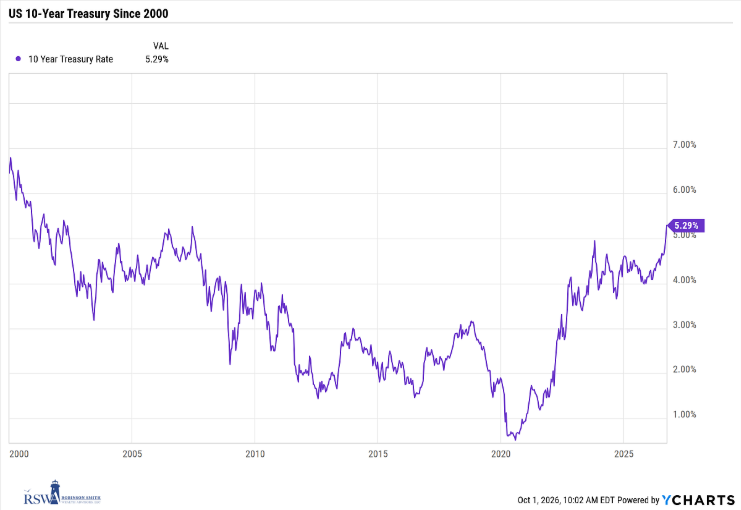
While it may not be the most exciting topic, interest rates are dominating headlines and investor attention. And for good reason. The 10-year Treasury rate, one of the most important interest rates due to its relationship with so many forms of debt, now sits near 5.3%, its highest level since the spring of 2002.
While crossing the arbitrary 5% threshold may have more of a psychological impact than a true market or economic impact, the pace at which interest rates have risen has grabbed a lot of attention. On March 2nd of this year, the 10-year Treasury hit a recent low of 3.9%, and over the following seven months has rocketed up to the level we see today. Many factors are at play. Inflation remains a concern, economic growth is still strong, and there has also been a massive amount of bond issuance. When the market has more supply, higher interest rates are often needed to attract investors.
So, what does this mean for your portfolio?
Bonds
We’ll start with the bond side of the portfolio since interest rates have a more direct impact here. Bond values and interest rates have an inverse relationship: when interest rates rise, bond values generally fall, and vice versa. So, with interest rates rising as described above, this has provided a significant headwind for bond returns in 2026.
Currently, the US Aggregate Bond Index (AGG) has declined about 2% since the start of the year on a total-return basis.
However, there is a bright side to this equation. As interest rates have risen, newly issued bonds are now paying higher yields to investors going forward. If interest rates stabilize or trend downward in the future, bond investors could see a tailwind from these higher-yielding bonds. Potentially, short-term pain for long-term gain.
Stocks
As is usually the case, stocks are much more difficult to forecast. Interest rates do play a role in stock returns. Higher interest rates can create more competition for stock investors, valuations are influenced by interest rates, and companies themselves may be directly impacted by higher borrowing costs. But there are also a multitude of other factors at play at any given time.
Financial writer Michael Batnick summed up the current moment in the stock market quite well: “There is a lot of doubt, but no fear.”
Investors have become cautious about many areas of the market, including AI spending and growth, overall economic growth, and valuations. But the CBOE Volatility Index (VIX), a common measure of expected stock market volatility, sits below 16, which is on the low end of its typical range. This suggests that, despite the concerns investors have, there is relatively little expectation of significant near-term market volatility.
This backdrop has led some forecasts to suggest that slower or lower forward returns may be in store. At the same time, the current market environment does not necessarily point to a major decline being imminent.
Financial Planning Corner:
Roth Conversions: Timing and Strategy Matter
As the calendar flips to the fourth quarter, our year-end tax planning conversations ramp up. One of the strategies we frequently consider in client financial plans is Roth conversions.
A Roth conversion itself is fairly straightforward: it moves money from a traditional pre-tax retirement account into a Roth IRA, with income tax generally owed on the amount converted. (For more on why we love Roth assets, check out our blog article: RSWA – Roth IRAs: 8 Essential Rules and Strategies)
While a Roth conversion can be a valuable tax-planning strategy, the timing and amount of the conversion matter. When considering a Roth conversion, we look at several factors:
- Tax rate today vs. future: Does it make sense to pay taxes now rather than potentially at a higher rate later? Lower-income years can be particularly attractive for conversions.
- Medicare IRMAA: A large conversion can increase your income enough to trigger higher Medicare premiums, generally two years later.
- Future RMDs: Converting pre-tax assets to Roth can reduce future RMDs and the resulting taxable income.
- Estate planning: If your children are likely to inherit the assets, consider their future tax rates as well. Paying the tax today could allow them to inherit Roth assets rather than taxable traditional IRA assets.
- Access to converted funds: For individuals under age 59.5, each Roth conversion is subject to its own five-year holding period for purposes of the 10% early-withdrawal penalty. Once an individual reaches age 59.5, this early-withdrawal penalty no longer applies to converted amounts.
There is no one-size-fits-all answer when it comes to Roth conversions. The right amount and timing depend on your broader financial picture, and in many cases, the goal is to make smaller, strategic conversions over several years rather than converting everything at once.
That’s why Roth conversions are often less about making a single decision and more about finding the right opportunities over time.
Quick Hits:
- Big changes could be coming to college sports: The new Senate bill, the “Protect College Sports Act,” could bring some guardrails to the current Wild West of college sports AP News
- Meta Muse made waves when it launched earlier this month, but what is it actually like to use? WSJ
- It's officially spooky season: Find haunted houses, pumpkin festivals, ghost tours, and more happening across New England Halloween New England
- Maine takes the top spot for the best work-life balance in the US Visual Capitalist
Catch a Film at the New Hampshire Film Festival!
We’re excited to be a sponsor of the New Hampshire Film Festival for the second year in a row! The 24th annual festival runs October 15–18 throughout downtown Portsmouth and brings together filmmakers, screenwriters, industry professionals, and film lovers for four days of screenings and events. As an Academy Award-qualifying festival, it’s a pretty cool event to have right here in our backyard.
RSWA also has access passes available for daily screenings and events at venues throughout downtown Portsmouth. You should have received an invitation with more information about the festival and access passes. If you’re interested in attending or have any questions, just reach out to your RSWA contact and we’ll be happy to get you set up!
Quote: “Enjoy the little things, for one day you may look back and realize they were the big things.” Robert Brault
Thank you for reading RSWA Financial Advisor Insights! We welcome feedback, and please forward this to a friend! Be well, take care, and stay safe!