Now that we are in the second quarter, we can look back at how the first quarter of 2026 fared. To put it bluntly, Q1 was not a good quarter for the markets but the results may not have been as bad as it felt. The S&P 500 closed down 4.6% for Q1. With war in the Middle East, disruption to global oil supply routes, and continued uncertainty around AI, a 4.6% decline in the S&P 500 may have been milder than many feared. It could always be worse. That may offer limited comfort, but it’s worth keeping the broader context in mind.
Looking a little deeper, the Mag 7 was down 13% in Q1. One of the contributing factors is that tech companies are financing their spending for the AI buildout through borrowing by issuing more bonds. With this, their stock prices are more impacted by changes in interest rates. With inflation going up due to the Middle East conflict, interest rate cuts appear less likely in the short term. This will continue to weigh on the tech stocks. Axios Markets
Housing Inflation:
As inflation stays higher than the Fed target, it is worth taking a closer look at one component in particular. When inflation is calculated, housing (mainly shelter) accounts for about 36% of the Consumer Price Index and is the largest category. We continue to hear that homes have become so expensive that getting into the housing market is out of reach for many people. Is that accurate? What does the data tell us?
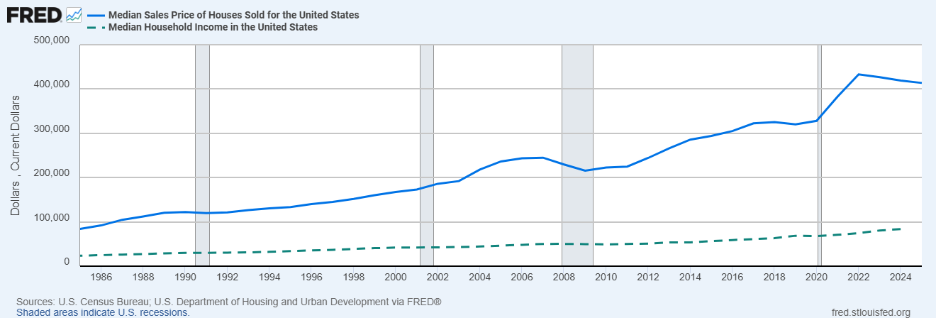
If you look at this graph, you will see the comparison of median sales price of houses and median household income. In 1985, the median house cost 3.6 times the median household income. By 2024, the median home price had risen to roughly 5 times median household income. If you go back to 1960, the median house cost 2.1 times the median household income.
Why have homes become more expensive? One change is the idea of what a starter home is. In the 1960s a starter home was a small, simple home that usually had two to three bedrooms and one bathroom. Often these homes were at or under 1,200 square feet. Today, starter homes have multiple bathrooms, open layouts, garages and are often 1,500 to 2,000 square feet. Builders often favor larger homes because profit margins are typically higher. Fixed costs including land and permits can make smaller homes less profitable. Land has also become more expensive and now represents a larger share of total construction cost. In some areas, land can account for 30-60% of the total price of a new home. Zoning rules can also add to the problem by requiring minimum lot sizes.
At the same time, consumer preferences have shifted toward larger homes with more amenities including larger kitchens, multiple bathrooms and central air conditioning.
How much home could a median income buy?

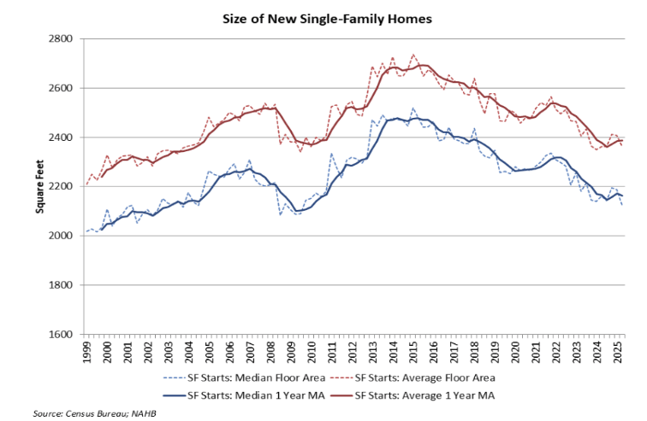
So, if the median income in 2025 can buy a home similar in size to previous decades, why is there an affordability issue? For that, we look at the size of new homes being built. If a home that is less than 1,800 sq ft is affordable, but the median home being built is 2,200 sq ft, we have a problem. And that is exacerbated by the fact that for over a decade the homes being built were even bigger than the median is now. With fewer and larger homes being built, we now have an affordability issue that will not fix itself overnight.
Financial Planning/Investment Strategy Corner:
Best Ways to Help the Next Generation Start Saving: In last week’s newsletter, Wes wrote about the new “Trump Accounts.” The new accounts are one way to help the next generation start saving but what are the other options? 03.27.26 RSWA Newsletter
- 529 accounts: Offer tax-free growth when used for education including college, trade school and professional credentialing programs. The accounts can also be used for up to $20k annually for K-12 private schools. And there is now an option to convert up to $35k into a Roth IRA in the name of the beneficiary if all the funds are not used for education. These accounts can be front-loaded with up to five years of annual exclusion gifts.
- UTMA/UGMA accounts: The acronym stands for Uniform Transfers/Gifts to Minors Act. Most people call these custodial accounts because an adult has control over the account as the custodian. These accounts must be used for the benefit of the child and passed to the child outright at the age of majority. This is usually between 18 and 21 depending on the state. These accounts are taxable investment accounts and do not have contribution limits.
- Trusts: Trusts are written by an attorney and can be written to have more flexibility than the UTMA/UGMA accounts that must follow the age rules set in the act. Assets in a trust can be held until the child is older than the UTMA/UGMA requires.
- Roth IRAs: One of our favorite ways to help the next generation save is for the child to open a Roth IRA once they start earning W-2 income. With a part-time job, they can start saving in a Roth IRA and have a lifetime of tax-free growth.
- Easter is this Sunday. Here are some recipes for anyone who is scrambling last-minute: 40 Best Easter Dinner Ideas for a Sunday Family Feast
- Lonely space movies – they have a list for everything! 7 Space Movies to Watch if you Loved 'Project Hail Mary' | GQ
- Practicing mindful acceptance – I keep trying! How to Let Go of Little Annoyances How to Practice Acceptance
- The Portland Museum of Art is growing: Portland Museum of Art completes $14M deal for Free Street properties
- "Freedom is not merely the absence of oppression, but the presence of opportunity.” - Ruth Bader Ginsburg
- “‘Twas Easter Sunday. The full-blossomed trees filled all the air with fragrance and with joy.” - Henry Wadsworth Longfellow
- “All I really need is love, but a little chocolate now and then doesn’t hurt!” - Charles M. Schulz
Quick Hits:
Artemis II:
On Wednesday, April 1, Artemis II launched from Kennedy Space Center, sending four astronauts — three Americans and one Canadian — on a 10-day trip around the moon. They will go, for the first time, to the far side of the moon and set a record for the farthest distance a person has ever traveled from Earth at about 252,000 miles. The mission is intended to lay the groundwork for future missions to land on the moon. If the current timeline holds, a moon landing could follow in 2028. It will be the first time in 56 years. The last moon landing was Apollo 17 in December of 1972.
To all who celebrate Easter and/or Passover, I hope you enjoy your celebration.
A Few Quotes:
Thank You for Reading
Thank you for being part of the RSWA community and for reading Financial Advisor Insights!
We welcome your feedback — and please share this with a friend or colleague who might enjoy it.
Be well, take care, and stay safe!