One of the most rewarding parts of my job is educating and empowering our clients to make sound financial decisions. Knowing that you have someone on your side who has a legal obligation to act in your best interest is paramount when dealing with your money and wealth. That is why the term “fiduciary” is something we are proud to be. A term that 10-20 years ago may have been unfamiliar to most is now prevalent on websites, television, radio etc. So, what exactly does the term fiduciary mean? A fiduciary is a person or firm who acts on behalf of others and is obligated to always put their clients’ interests first. There has been a legal battle occurring in the financial services industry over the last couple of years on exactly who is held to a fiduciary duty, and ultimately who should be. There was a sense of resolution in this ongoing battle earlier this month:
Second Judge Vacates DOL Fiduciary Rule, Dealing Death Blow
While great from a marketing perspective for RSWA, the ruling is not an ideal outcome for consumers. This is not to turn you off from using a financial professional who is not a fiduciary. It is more to empower you to ask a couple of very important questions when deciding to use the services of one: 1) Are you a fiduciary? 2) How do you get paid? While our job is to educate and not denigrate, it's crucial to understand the obligations and level of care certain professionals are held to when engaging their services.
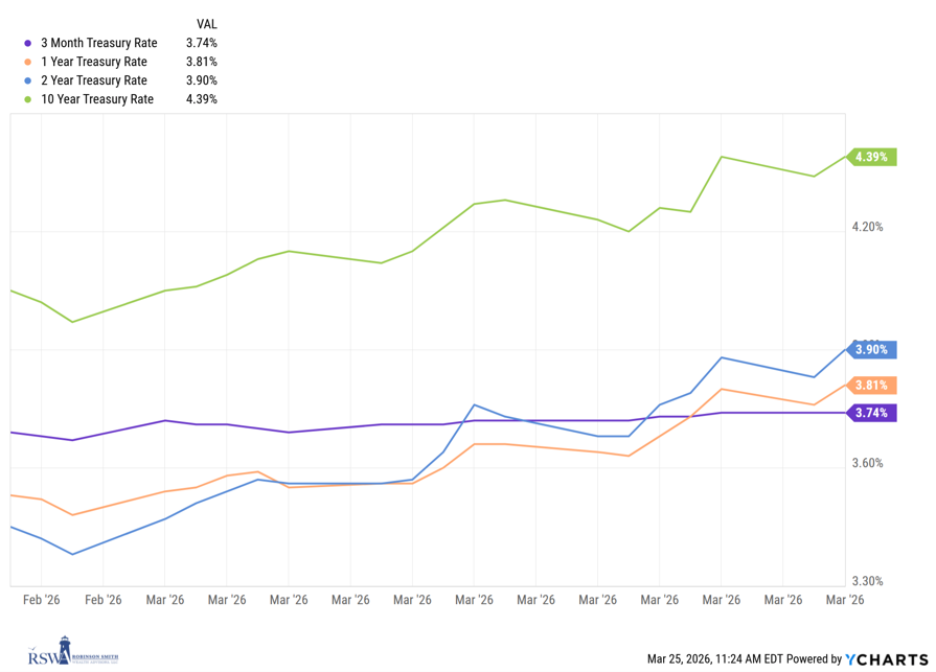
Move in 10-Year Yields – the Rollercoaster Continues
Housing affordability remains one of the biggest impediments for many in the pursuit of the American Dream (with some questioning whether that’s even part of it anymore). The traditional 30-year fixed-rate mortgage is closely tied to the 10-year Treasury. 30-year mortgage rates are determined based on the current 10-year Treasury yield + spread – usually that spread is around 2-3%. With the dramatic increase in the 10-year Treasury since the start of the Iran war, if you blinked, you missed an opportunity to jump on a rate below 6%. With the cost of living continuing to be the main concern for Americans, rates are trending in the wrong direction. I think we all would like to see a quicker end to the conflict, with just one variable being inflation. Below is a chart of the move in the 10-year yield over the last month, increasing from 4.01% to 4.39%:
Financial Planning Corner
530A Accounts (aka Trump Accounts)
One of the features of the One Big Beautiful Bill Act (OBBBA) that was signed into law last July was the establishment of 530A accounts – almost uniformly referred to as Trump Accounts. While the name of the account may turn some people away, the idea behind it is a powerful one. The legislation, deemed by the administration as a “Jumpstart to the American Dream” passed many months ago. However, guidance by the IRS has taken a while to come out regarding the nuances of how Trump Accounts will work - taxation, distribution options, etc. As of now, we have some clarity, but not full transparency. Any child born between January 1, 2009-December 31, 2028, is eligible for Trump Accounts. However, it’s those born from January 1, 2025-December 31, 2028, who are eligible for the $1,000 Pilot Program Contribution by the U.S. government. Individuals eligible for the Pilot Program Contribution are immediately able to participate in one of the greatest wealth creating tools available, the U.S. stock market, from birth. When the child turns 18, the account becomes theirs. Some of the key provisions of Trump Accounts:
- Accounts become active on July 5, 2026
- The owner of the account (which is the parent/guardian or any other authorized individual who established the account), will need to complete the following: Trump Accounts - Jumpstarting the American Dream; or Form 4547 (December 2025)
- Parents/guardians, or any other authorized individual, can contribute up to $5,000/year until the year in which the child reaches age 18
- Employers may contribute up to $2,500 per employee’s dependent (this is an annual employer limit i.e. the $2,500 applies for multiple dependents, not per dependent)
- Investments available are limited to U.S. Index Funds or ETFs, specifically the largest companies (those that make up the S&P 500)
- When the child reaches age 18, the Trump Account is automatically converted to an IRA that is now the child’s
- At that time, funds are at the ultimate discretion of the child, and will operate much like a Traditional IRA
- Ability to convert to a Roth IRA at age 18, or whenever is optimal for their situation – potentially allowing for decades of tax -free growth – (more detail here - The Hack That Turns Trump Accounts Into Multimillion-Dollar Tax-Free Nest Eggs - WSJ)
Ultimately, we will have full transparency/guidelines for how these accounts will operate, and even though we aren’t quite there, it’s prudent to start thinking about if these accounts make sense for you and your family.
Quick Hits:
- With March Madness entering its second week (and my Vols headed to the Sweet 16 😊), only one perfect bracket remains, and it is on the women’s side: Still the 1. One perfect women's March Madness bracket going into Sweet 16 (somewhere between 35-40 million brackets were submitted for the men’s and women’s tournament).
- I made a quick trip down to Philly for the first couple rounds – great to celebrate with (most) of my family:
- Opening Day of Major League Baseball is here, best of luck in the 2026 season for whichever team you root for. Here are the ‘experts’ predictions: 2026 MLB predictions: Playoffs, World Series, MVPs and more - ESPN
- Whether celebrating Easter for religious reasons, or for the first taste of spring, here some fun ideas for the family: 50 Great Easter Egg Hunt Ideas the Whole Family Will Love
- I have a brother outside of D.C. and will eventually coordinate a trip down there for this: Cherry blossoms in DC: A guide for spring 2026 – NBC4 Washington

Quote:
“No winter lasts forever; no spring skips its turn.” – Hal Borland
Thank You for Reading
Thank you for reading RSWA Financial Advisor Insights! We welcome feedback, and please forward this to a friend! Be well, take care, and stay safe!