On Wednesday, inflation numbers were reported. The Consumer Price Index (CPI) rose by 2.4% for the year. Core CPI, which takes out food and energy costs, rose by 2.5%. Both are above the Federal Reserve’s 2% target but are in line with expectations. Last week, employment data was released with total non-farm payroll being reduced by 92k, and the unemployment rate staying about the same at 4.4%. This leaves us in a spot where we have both higher inflation and lower job growth than the Federal Reserve targets. And this is all before the conflict in the Middle East, which has oil prices rising quickly.
Are We Looking at “Stagflation”?
Over the last few days, there seem to be more headlines mentioning stagflation. First, what is it? Stagflation is a term that was popularized by British politician Iain Macleod in the 1960s. It combines the idea of high inflation and stagnant economic growth into stagflation. In 1965, Macleod warned the House of Commons that “We now have the worst of both worlds—not just inflation on the one side or stagnation on the other, but both of them together. We have a sort of "stagflation" situation. “
Stagflation came to our side of the pond in the 1970s. There were multiple factors that contributed:
- Expansionary monetary policies in the late 1960s and 1970s were focused on maintaining full employment but contributed to inflation.
- In 1973, the OPEC oil embargo caused oil prices to quadruple and the Iranian Revolution in 1979 caused oil prices to almost double again.
- High government spending for the Vietnam War and social programs under the Great Society initiatives increased budget deficits, which fueled inflation.
- The US ended the gold standard leading to the depreciation of the dollar which contributed to inflation.
- In 1971, Nixon imposed wage-price controls in an attempt to reduce inflation, but when the controls were lifted in 1973, inflation jumped again.
- Slowing productivity growth contributed to wage stagnation and slowing economic growth.
So, are we looking at a return to stagflation? How does our current economic backdrop compare to the 1970s?
- Inflation is much lower today. It averaged 7-8% for the 1970s, peaking at 13.5% in 1980. Today it’s 2.4%. We did have a peak of 9% in 2022.
- Unemployment is lower today. In the 1970s, unemployment averaged almost 8% annually, peaking in 1975 at 8.48%. In 1982 and 1983, it jumped even higher to 9.71% and 9.61%, respectively. Today it’s 4.4%. We did have a peak during the pandemic of 8.10%.
- Economic growth is stronger today. The US economy was in recession for the first 11 months of 1970 and from November 1973 to March of 1975. St. Louis Fed GDP Nowcast is forecasting Q1 2026 QDP to be 2.55%. The actual GDP numbers are released Friday morning, so we will see how close the forecast is.
- The US is now a net energy exporter. In the 1970s, we were very dependent on foreign oil. Now with a combination of renewable energy and US oil and natural gas expansion, the US is not dependent on foreign oil. Oil markets are priced globally, so prices still increase, but not to the extent they did in the 1970s.
One more difference is the Federal Reserve itself. The Fed now is much more aggressive about controlling inflation than it was in the 1970s. Lessons were learned.
So, are we facing stagflation? David Kelly, chief global strategist at JPMorgan Asset Management says, “if you want to use the word “stagflation” with a very little “s” you could.” Iran war raises stagflation concerns on Wall Street
Financial Planning/Investment Strategy Corner:
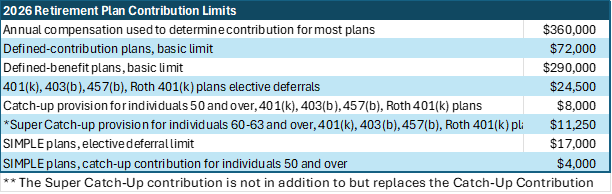
Last week, Donovan reviewed the 2025 contribution limits for IRAs and HSA to help everyone top off their accounts before the April 15th deadline. Donovan's Newsletter. This week, I figured it might be helpful to review 2026 information for 401(k)s and other employer sponsored retirement plans. Hopefully, it will help spread out any increases you can make over the rest of the year.
The Middle East Conflict Continues:
One question we hear often is what effect will this have on the markets? Our response continues to be it will depend on how long the conflict lasts and who gets involved. The longer the conflict lasts, the larger the effect. With 20% of the world’s oil moving (or not moving) through the Strait of Hormuz, oil prices will continue to be volatile. As of Wednesday morning, when I am writing this, the price of oil is $86.47 a barrel. It spiked to $119.47 on Monday. In February, it was between $62 and $65 a barrel. That is up about 35% in one month.
Who is profiting from the increase in prices? Countries with large oil reserves such as Norway, Canada, Nigeria, and Colombia. Not to mention the US. But the country that seems to be benefiting the most is Russia. Russian crude oil is now trading above the global price. Due to the Middle East conflict and the effect on oil transportation, Russia received a 30-day waiver on sanctions to sell oil to India. Axios Markets
Quick Hits:
- Today is Friday the 13th! For those horror movie lovers here is a list of all Friday the 13th movies. I saw at least one of them at the drive-in movies! Which just means I am old 😊 'Friday the 13th' movies
- St. Patrick’s Day is Tuesday – here are some Irish recipes: 28 St. Patrick's Day Recipes
- Best places to work in 2026 – I love that In-N-Out Burger is on the list. Who would think a fast-food place would make this list! The Best Places to Work in America in 2026
- Maine is growing but not as fast as South Carolina! Which U.S. States Gained the Most Residents in 2025
- The crazy things you find when searching the web – pregnancy in space! Floating Babies and Zero-Gravity Birth
A Few St. Patrick’s Day Quotes:
- “Beer makes you feel the way you ought to feel without beer.” — Henry Lawson
- “To be Irish is to know that in the end the world will break your heart.” — Daniel Patrick Moynihan
- “All that is gold does not glitter, not all those who wander are lost; The old that is strong does not wither, Deep root are not reached by the frost.” ― J.R.R. Tolkien
Thank You for Reading
Thank you for being part of the RSWA community and for reading Financial Advisor Insights!
We welcome your feedback — and please share this with a friend or colleague who might enjoy it.
Be well, take care, and stay safe!