January’s inflation report showed prices rose 2.4% year-over-year, lower than markets expected. Core CPI, excluding food and energy, rose 2.5% over the same period, the lowest since 2021. With job data released last week showing the unemployment rate falling to 4.3%, this points to the Federal Reserve staying on hold with interest rate cuts as unemployment and inflation are both falling. U.S. Inflation Unexpectedly Fell in January, CPI Shows | USA Today
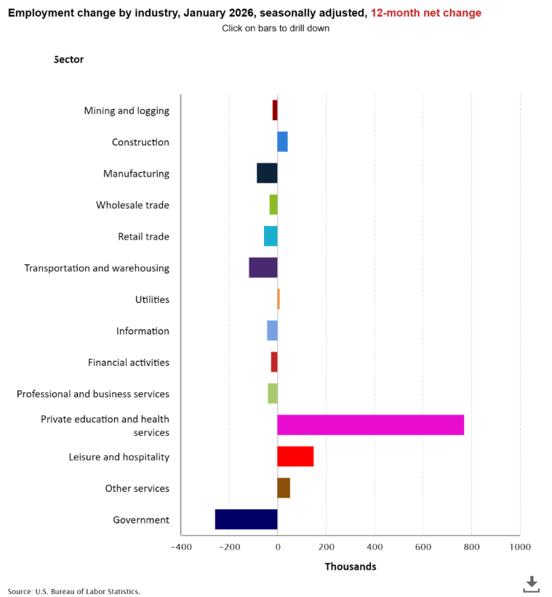
The unemployment picture is interesting. According to the Bureau of Labor Statistics, in the past year, only five industries had job gains, and the gains are dominated by healthcare, with job growth of 773k in the past year:
The Bureau of Labor Statistics data set is pretty neat because you can then click into the chart and see what sub-industries make up the job gains:
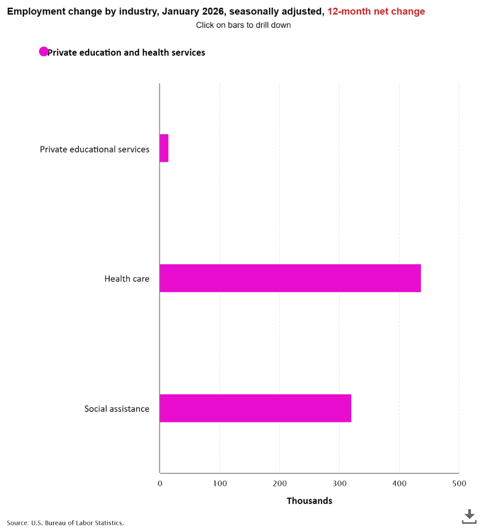
Breaking down the categories further, healthcare (+467k in jobs) and social assistance (+320k) drove the sector. You can go one click further (I’ll let you do that), and the job gains in social assistance gains go to individual and family services (+313k) and the gains in healthcare go to ambulatory health care services (+198k), hospitals (+149k), and nursing and residential care facilities (+90k). The individual family service sector is made up of 2/3’s home health care. So, what is driving a lot of job gains in health care is a demographic issue where an aging population requires more health care and assistance. The oldest baby boomers in the United States are 80 years old, and the youngest are 62, so this may continue for the economy and employment picture, with a similar impact to the number of teachers needed in the 1960s and 1970s to educate the baby boomers. This article looks into the job gains and demographics a bit more: The Story of the Trump Economy? Old People | Yahoo Finance
“Boomcession?”: With the change in employment decreasing in some industries, that could explain why consumer sentiment is low, even while the United States economy is growing. The idea is that while the economy is growing, the average American doesn’t feel like they are participating in the economy: 'Boomcession': Why Americans Feel So Bad About a Growing Economy. Beyond the recent employment data, inflation over the past five years is certainly taking its toll, with grocery and shelter inflation increasing the most amongst categories. Those categories disproportionally make up more of the spending of low to middle-income families compared to higher-income groups. The “Labor Share”, the percentage of economic output for workers as compensation, also reached historic lows in 2025:
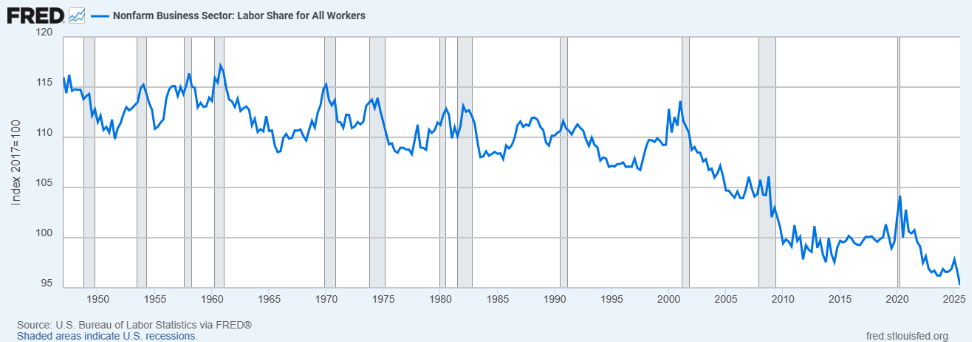
All of this may also explain why some polls point to nearly 60% of Americans feeling the United States is currently in a recession, when the economy is in fact growing.
Financial Planning/Investment Corner:
Working with clients to prepare for retirement can sometimes go beyond financial planning and numbers on a screen. Retirement is a large life event, going from saving to spending, but also filling the time and replacing your previous identity. The WSJ had an interesting piece recently on a couple, where the husband is struggling to find purpose, and while the wife is thriving: What Surprised These WSJ Columnists Most About Retirement | WSJ. While the wife worked, she also maintained hobbies and volunteered, leaning into them further in retirement. The husband is having trouble finding something to fill the void from his previous career as an editor, which provided him stimulation and variety, as well as a sense of gratification. Reading the article, I got to thinking that my wife and I joke that we have too many hobbies, so it won’t be an issue whenever we retire, but that isn’t the case for everyone. I would offer a few suggestions to the husband:
- Find a volunteer opportunity that you find gratifying and make it a consistent, scheduled event to give you structure.
- Develop human connections. Retirement can be a lonely feeling.
- Find ways to share your expertise with others by finding a professional group to mentor or guide (I guess writing this article and their blog may count towards that).
All of this is to say, retirement is beyond the financials, and it is a major life adjustment. There are a lot of meetings where we ask clients what they would do when they retire. We also get to sit at the table and find out who is retiring the right way.
Quick Hits:
- I just found out that Jessie Buckley, the Irish star of Hamnet, sang her own songs from the movie Wild Rose, and she is very talented: Jessie Buckley - Boulder to Birmingham | YouTube
- With stock and bond markets up in 2025, it’s not a surprise that Maine University Endowments are up, but the news is even better for some: Most Maine School Endowments Outperformed National Average | Press Herald
- I went ice fishing for the first time this weekend but didn’t catch anything: The Winning Fish From the Sebago Lake Ice Fishing Derby | WMTW
- My nephew was part of the team that won the New Hampshire state title for the 4 x400m relay. It was pretty cool because I was able to watch it live, streaming on YouTube from my kitchen in Maine: State Track Results | Concord Monitor
Utah Pioneers a New Model for Wildfire Resistance: This is more of a selfish plug. My wife’s cousin works for the World Resources Institute and coauthored this article: Utah Pioneers New Model for Wildfire Resilience | World Resources Institute. I remember a visit from James to Maine over 10 years ago, and he had with him his computer and a map he had developed that went over the most efficient and effective regional sources of energy all across the United States (it may have been the world). He was so passionate about the project – it was pretty inspiring.
Quote: “It is inhumane, in my opinion, to force people who have a genuine medical need for coffee to wait in line behind people who apparently view it as some kind of recreational activity.” – Dave Berry
Thank you for reading RSWA Financial Advisor Insights! We welcome feedback, and please forward this to a friend! Be well, take care, and stay safe!