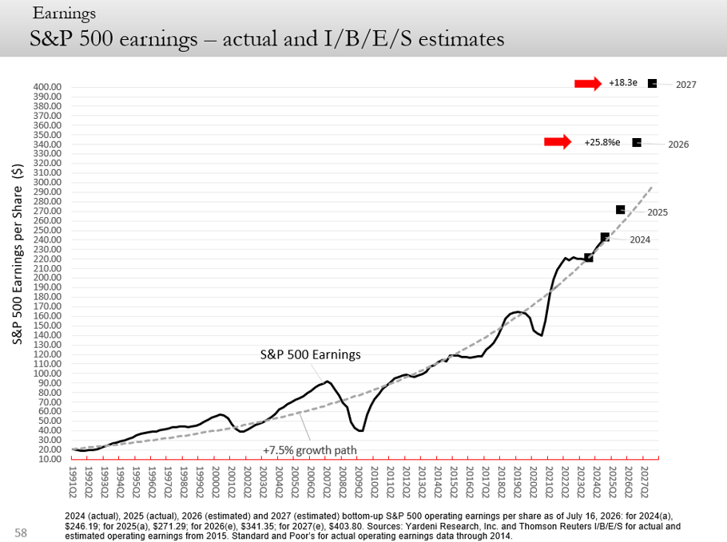
Earnings Are the Story Behind the Market’s Strength: Clients often ask why the stock market continues to perform well despite uncertainty surrounding geopolitical conflicts, AI disruption, inflation concerns, and upcoming elections. The answer, as we have written many times over the years, is surprisingly simple: Over the long run, stock prices follow corporate earnings. Historically, S&P 500 companies have grown earnings at roughly 8% per year, and when combined with dividends of approximately 2% annually, it explains why stocks have historically returned about 10% per year over long periods.
Today, however, we are witnessing something extraordinary. Wall Street currently expects S&P 500 companies to grow earnings roughly 26% in 2026, followed by another 18% in 2027 (see chart below). Those are growth rates rarely seen outside of recoveries from major recessions. Much of this acceleration is being fueled by massive AI-related investment, improved productivity, energy companies benefiting from higher oil prices, and resilient consumer spending. So far in Q2, 62% of companies have reported earnings. Compared to last year’s Q2 earnings, they are up an astronomical 47% so far. Even after stripping out the eye-popping gains reported by companies such as Alphabet and Amazon, whose reported profits were boosted by large, unrealized investment gains rather than day-to-day operations, Q2 earnings for the remainder of the S&P 500 are still up nearly 29% compared to last year’s. In other words, while a few headline numbers may overstate the strength somewhat, the underlying earnings picture remains remarkably healthy.
Markets can certainly experience pullbacks along the way, but strong and growing earnings remain one of the most reliable long-term drivers of higher stock prices. Headlines often dominate daily conversations, but company profits ultimately determine where stock prices go over time. Axios WSJ
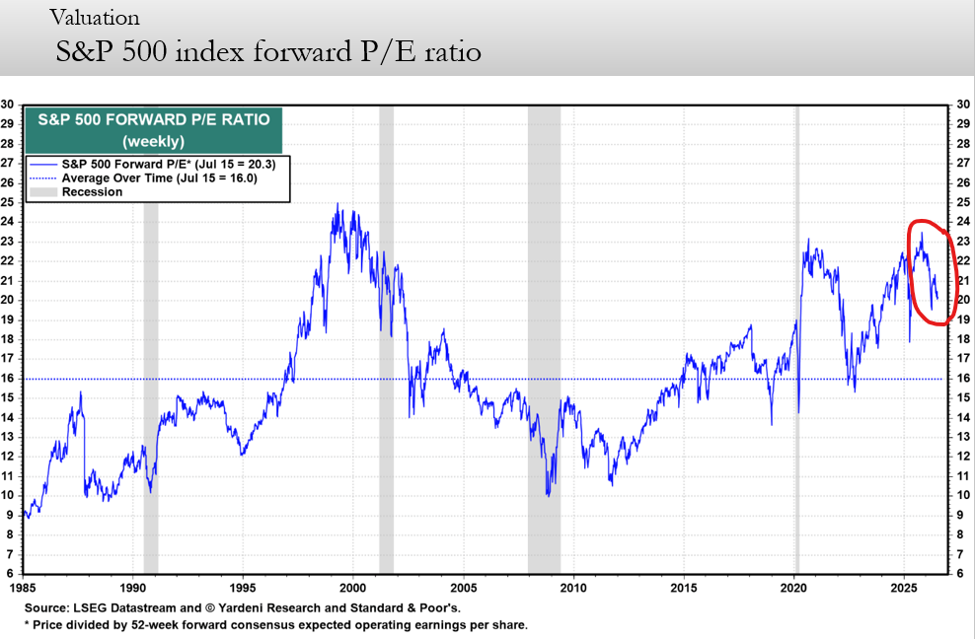
Does This Mean Stocks are Expensive? One of the most common ways investors evaluate valuation is by using the price-to-earnings (P/E) ratio, which simply measures how much investors are willing to pay for each dollar of corporate earnings. Historically, the S&P 500 has averaged a P/E ratio of roughly 16, although that number alone has never been a particularly reliable predictor of future market returns. Investors are generally willing to pay higher valuations when economic growth is healthy, interest rates are stable, and corporate earnings are expected to continue expanding.
At the beginning of this year, the S&P 500 traded at approximately 23 times earnings, well above its historical average. Yet despite strong gains in stock prices during 2026, the market's P/E ratio has actually fallen to roughly 20. Why? Because earnings have grown even faster than stock prices. In other words, although the market has appreciated, corporate profits have increased so dramatically that stocks are actually less expensive today than they were at the beginning of the year. That relationship is highlighted by the red circle in the accompanying chart and illustrates why looking only at price can often paint an incomplete picture.
Podcast Review:
The Knowledge Project Podcast: The Mindset That Unlocks Your Full Potential, Dr. Gio Valiante
One of the best podcasts I've listened to this year features Dr. Gio Valiante, one of the world's leading performance psychologists. Some may remember Gio spoke at a couple of RSWA events back in 2017. I found his books and interviews so insightful and helpful; I have followed him ever since. Over the past three decades, he has worked with elite performers including: PGA Tour champions, major championship winners, hedge fund managers, CEOs, and professional athletes. His specialty isn't teaching people new skills; it's helping talented people consistently perform at the highest level when the pressure is greatest.
Several ideas from the interview stood out. First, excellence isn't built on motivation; it's built on behavior. Waiting until you "feel like it" is a losing strategy. Action comes first, and confidence follows. Second, Dr. Valiante distinguishes between pursuing mastery versus pursuing validation. Those who are focused on continually improving tend to outperform those who are primarily concerned with proving themselves to others. Finally, he emphasizes that our environment often shapes success more than our goals. The people we spend time with, the routines we establish, and the small daily habits we repeat ultimately determine where we end up. Whether investing, building a business, improving our health, or raising a family, consistent small actions compounded over time almost always outperform bursts of inspiration.
The Knowledge Project: The Mindset That Unlocks Your Full Potential | Dr. Gio Valiante
Financial Planning/Investment Strategy Corner:
The One Page Financial Organizer: We are into the last long and hot days of summer and taking it all in before you know what happens. I’m sure no one wants to start a big financial planning project, so maybe it’s time to focus on an important but easier accomplishment, such as a One Page Financial Organizer. This is no more than a list that every family should have that can be easily located. Here are a few things that should be on that list:
- Estate documents
- Financial accounts
- Insurance policies
- Password manager
- Trusted contacts
- Safe deposit box information (or codes and keys to the house fireproof safe)
- Anything else you can think of that is important!
Having everything on one sheet of paper not only helps you organize and track your financial life, but it can help save spouses and children many hours in the case of death or disability. So, if you find yourself with a little time and only a little motivation at the moment, creating a One Page Financial Organizer is one way to be productive without too much effort.
Quick Takes:
- Renewable energy in the U.S. is still booming: Visual Capitalist
- Peas are in season and just happen to be packed with protein and good carbs (link with info and some recipes – including pea pesto!): NYT
- And tomatoes are in season too – more recipes! New England
- After three years, the new season of Ted Lasso is finally out: CNET
Book Review #1: Rethinking Investing: A Very Short Guide to Very Long-Term Investing by Charles D. Ellis
If I could give one short investment book to every young adult starting their financial journey, Rethinking Investing by Charles Ellis would be near the top of the list. Unlike many investing books that promise secret formulas or quick riches, Ellis focuses on timeless principles that have consistently worked for generations. He explains why saving early matters far more than finding the "perfect" investment, why diversification remains one of an investor's greatest protections, and how the incredible power of compounding can quietly build wealth over decades. The book is refreshingly short, which can be read in a couple of hours. But its lessons can influence financial decisions for a lifetime. I like it especially for young adults, for them to learn that the greatest advantage isn't stock picking or market timing; it's time itself. Starting just a few years earlier often matters far more than earning an extra percentage point of return. If you have a young adult interested in learning big lifelong lessons in investing, it’s a great book to start on that journey. Amazon: Rethinking Investing
Book Review #2: The Temporary European, Lessons and Confessions of a Professional Traveler by Cameron Hewitt
Rick Steves fans already know Cameron Hewitt as one of Europe's most knowledgeable travel writers. When COVID hit and he was at home, he wrote the book when he couldn’t travel, and I can’t believe I missed it for a few years. The Temporary European offers something far more personal than a guidebook. Rather than telling readers where to stay or what museums to visit, Hewitt shares what it feels like to live among Europeans and not simply travel through Europe. Through humor, thoughtful observations, and plenty of self-deprecating stories, he explores the cultural differences that shape everyday life, from leisurely meals and neighborhood cafés to attitudes toward work, family, and happiness.
Cameron even goes into what his favorite countries are (Slovenia), big cities (Budapest, London, and Berlin), and small cities (Ljubljana, Slovenia, Gdansk, Sarajevo). He also goes into his least favorite countries (Spain, Romania, Slovakia, Austria), overrated cities (Salzburg, Milan, Vienna), and least favorite cities (Bucharest, Catania, Bratislava), plus ratings on many more areas. It was fun reading his insights as to why something was a favorite or not.
One of the book's greatest strengths is its reminder that travel isn't merely about checking destinations off a list. The richest experiences often come from slowing down, becoming curious, and seeing familiar things from someone else's perspective. Even if Europe isn't on your travel plans this year, the book is an enjoyable reminder that some of life's best lessons come from stepping outside our routines and embracing a different way of living.
Amazon: The Temporary European
Quote: “It doesn't matter what you believe or feel. It just matters what you do.” Dr. Gio Valiante
Thank you for reading RSWA Financial Advisor Insights! We welcome feedback, and please forward this to a friend! Be well, take care, and stay safe!