Federal Reserve Chairman Kevin Warsh led his first Federal Reserve meeting last week. Largely, markets anticipated the Federal Reserve leaving policy rates where they are as inflation remains stubbornly high. The statement from the Federal Reserve, 186 words fewer than the previous meeting, took a hawkish tone, stressing “the Committee will deliver price stability.” In the press conference, Warsh said “inflation is a choice” and outlined creating a series of task forces around:
- Federal Reserve Communications: Reducing forward guidance and eliminating the press conference
- The Balance Sheet: Focus on reducing the Federal Reserve’s Balance sheet
- Economic Data: Introducing real time data and fewer revisions
- Productivity and Jobs: Economic growth in a potentially transformative era, with low inflation
- Federal Reserve Inflation Framework: Introducing new inflation data points and measurements, like trim mean inflation
Warsh declined to submit his own forecast on the “dot plot,” signaling that he has little regard for the Federal Reserve's forecasts and wants less market speculation on how the Federal Reserve will react to events. Warsh suggests that markets digesting data and events on their own is better. Some argue that logic is circular because the market will always try to anticipate what the Federal Reserve will do, but now with less information and clarity from the Federal Reserve. This can potentially increase volatility if the market misinterprets the Federal Reserve’s next policy move. With former Federal Reserve Chair Alan Greenspan’s (“The Maestro”) passing this week at 100 years old, someone Warsh has paid homage to, some speculate Warsh is shifting his tone back to that era of the Federal Reserve being less committal. While Greenspan’s term lasted through four presidencies with periods of low inflation and growth, his legacy was tainted by overseeing two economic bubbles: the 1999 dot-com crash and the 2007-2008 housing bubble. Greenspan Playbook to Get a Replay Under Warsh | Reuters
Road to Housing Act: Congress acted on a bipartisan basis and passed a housing bill aimed at making housing more affordable. The law reduces regulations on manufactured housing and provides more funding to the localities building more homes by cutting funding from areas building fewer homes. The bill also reduces private equity’s influence on single-family homes by preventing private equity institutions from buying more than 350 existing homes. Congress Passes Housing Bill | Axios Critics of the bill point to the limits Congress has over local zoning and building codes (so be nice to your code enforcement officer vs. your Senators). Private equity institutions are not required to divest their existing owned homes, and the law excludes them if they are the ones that build more than 350 homes. The law does not apply to multi-family housing, where private equity tends to have greater ownership compared to single-family homes. The highest costs faced by homeowners are material and construction costs and higher interest rates, something the bill and Congress have little control over. President Trump has indicated he will refuse to sign the bill until voting legislation is taken. A Landmark Housing Bill Passed Congress. Home Builders Fear It Will Fizzle. | WSJ
Financial Planning/Investment Strategy Corner:
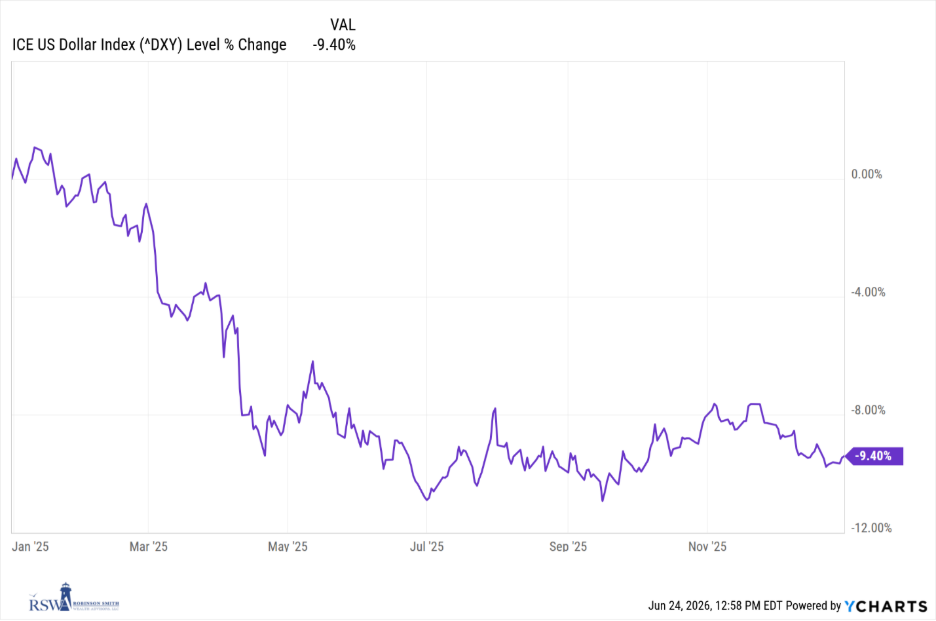
Last year was a weak year for the dollar as investors weighed policy measures enacted by the Trump Administration: implementing tariffs, ballooning national debt, and potential interest rate cuts. The dollar fell 9.4% in 2025 relative to other currencies:
Recently, though, the dollar has reached a 13-month high, and is up 3.1% year to date:
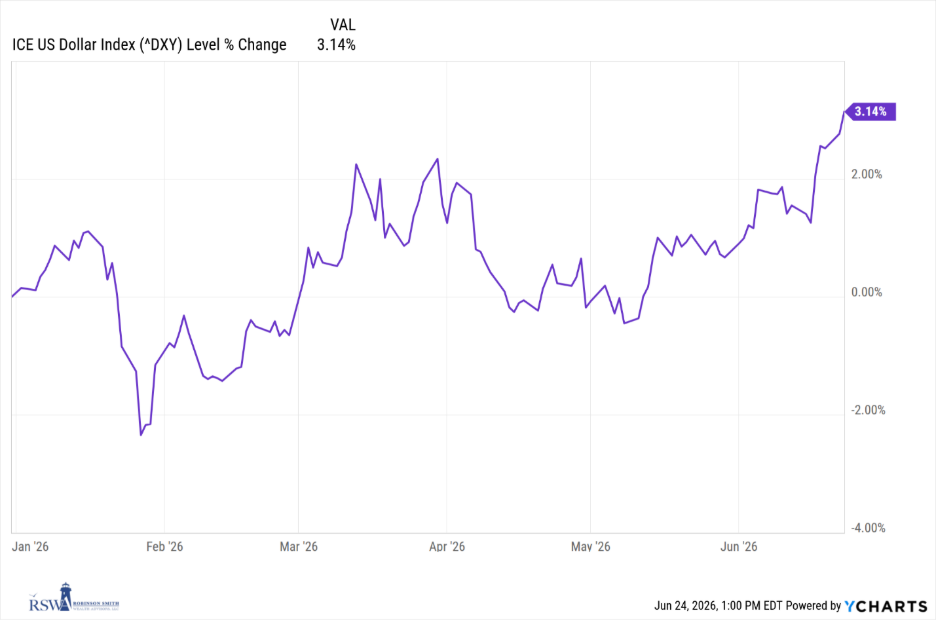
The move in the dollar is largely tied to the Federal Reserve’s hawkish policy shift, with interest rate increases being priced into the market. Higher U.S. interest rates mean international investors earn more holding U.S. debt, pushing up the dollar. The dollar has been behaving as a safe-haven currency due to international policy uncertainty. The war in Iran has also contributed to the dollar’s rise against the Yen, an oil importer, and the UK, which will have its 7th Prime Minister in 10 years, has seen the Sterling weaken. Overall, it’s hard to tell where the dollar will go from here, but the U.S. dollar remains the world’s reserve currency. The World Cup may also be a factor, with the dollar up 1.7% since June 12th 😊. U.S. Dollar Rises to 13-month High | Reuters
Quick Hits:
- Portland, ME is considered: The Most Walkable City in the U.S. | Travel & Leisure
- Financial Advice from America's Founders | Kiplinger
- A new Museum is opening in Lewiston, ME: Maine MILL | Museum of Innovation Learning and Labor
- My 18-month-old daughter has been laughing when we laugh at something, which makes me laugh more: Your Brain Has Separate Circuits for Belly Laughs and Polite Chuckles | Gizmodo
Quotes from Alan Greenspan: “I guess I should warn you, if I turn out to be particularly clear, you've probably misunderstood what I've said.” – Alan Greenspan
“I made a mistake in presuming that the self-interests of organizations, specifically banks and others, were such that they were best capable of protecting their own shareholders and their equity in the firms.” – Alan Greenspan
Thank you for reading RSWA Financial Advisor Insights! We welcome feedback, and please forward this to a friend! Be well, take care, and stay safe!