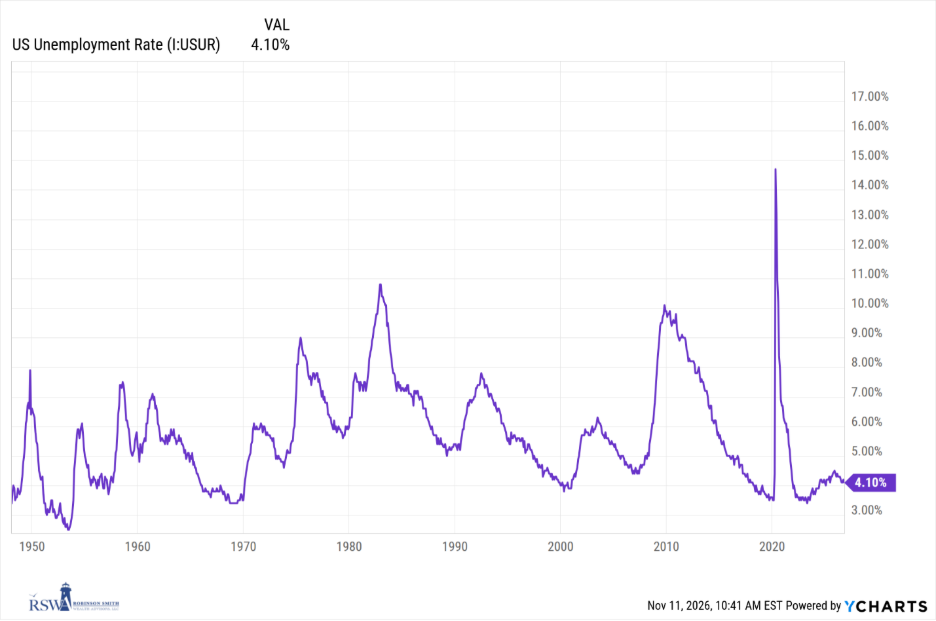
Last Friday brought a strong U.S. Bureau of Labor Statistics (BLS) labor report: 165,000 jobs were created in October, above consensus estimates of 65,000. The data also revealed upward revisions for August and September job numbers. The unemployment rate dropped to 4.1%, even as 421,000 people entered the labor force. US Employers Added a Surprising 165,000 Jobs in October | AP News. This period of low unemployment is likely to break a historic record. The unemployment rate has been under 5% for 62 straight months now, with the record being 64 months in the mid-to-late 1960s. US Unemployment below 5% | Yahoo Finance
Inflation Remains High: Inflation data released by the BLS Tuesday showed higher than expected inflation for the month of October, with the consumer price index up 0.4% vs. 0.3% expectations. Core CPI, excluding energy and food, rose 0.3% vs. 0.2% forecasts. With the government shutdown last October (remember that?), official survey data was not collected, so an official year-over-year number was not released. Shelter inflation accounted for 30% of the increase, while energy, tariffs, and the AI buildout have also pushed prices higher. Here's the inflation breakdown for October 2026 | CNBC
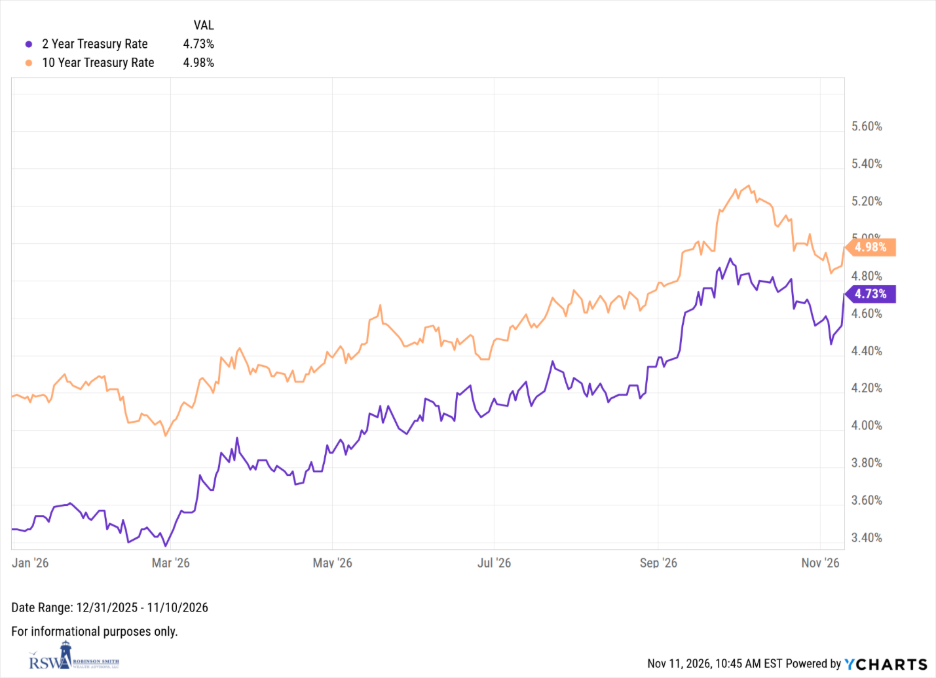
With a shift in the communication strategy by Federal Reserve Chair Kevin Warsh to reduce forward guidance and the number of interest rate-setting meetings, it will certainly allow him to spend more time “looking out the window” (He must be a big Bruce Horsnby fan). With less guidance from the Chair, the markets put further weight on communications from other Federal Reserve Governors. Federal Reserve Governor Chris Waller said he would be open to a 50-basis point move in December, and Dallas Fed President Lorie Logan indicated at least two additional quarter-point rate hikes may be required. Logan said the Fed could move “more rapidly this winter than the Fed has moved so far this Fall.” Bond markets reacted to Tuesday’s higher inflation report and comments, with the two-year Treasury yield jumping 17 basis points, the most since ‘Liberation Day.’ Bond Yields Surge Most in 19 Months| CNN Business. The Federal Reserve will not have another inflation report before its next meeting in December.
2027 Tax Rate Schedules Released: One of the effects of higher inflation is that some tax brackets and deductions are linked to inflation and increase. In 2027, the IRS increased brackets by 3.2%, which means taxpayers with similar income in 2027 compared to their income in 2026 will see some savings. The other meaningful increase is that the standard deduction increases from $16,100 to $16,600 for individuals and to $33,200 for joint filers. Child tax credits increase to $2,300 from $2,200. Lastly, the threshold for gifting to any one individual increases to $20,000 from $19,000. We all like the last one, mainly because it’s a nice round number. The 2027 Tax Brackets Are Here. See Where You Land. | WSJ
Financial Planning/Investment Corner:
S&P 500 vs. Housing: The Wall Street Journal conducted a study to see what returned more for investors: housing or investing in the S&P 500. Starting in 1985, they reviewed housing price data for metro regions and states and calculated their post-tax and post-liquidation annual returns. The Seattle metro region had the highest annual real return, +6.22%, while Idaho, as a state, was the highest at +5.90%. The S&P 500, after accounting for capital gains taxes, from 1985 to 2025 had annual returns of +7.57%. So, even the highest property price increases didn’t keep up with the S&P 500 over this time period, but they were less volatile, with the S&P 500’s volatility 16.9% vs. the average home price 9% a year. Is Buying a Home or Stocks the Better Investment? | WSJ
Keep Track of Your Retirement Accounts: Now that we know how important it is to stay consistently invested for long periods of time in the stock market, it’s even more important to keep track of old employer 401ks and retirement accounts. Workplace retirement accounts for former employees with balances less than $7k can be moved into Safe Harbor IRAs by the employer. These accounts are typically designed to be short-term (1-2 months), where the participant then transfers the account to a new retirement plan or existing IRA. The problem is 87% of participants leave the accounts after one year, and the accounts typically carry high opening and maintenance fees. The funds are also invested more conservatively, lowering potential returns. One study found that 68% of these accounts are worth less than when they started and 5% have lost nearly a quarter of their value due to fees. After 8 years, 52% of accounts in Safe Harbor IRAs remain, and 10% have lost over a quarter of their value. By contrast, $5,000 after 8 years with a 7.57% annual return in the S&P 500 would be nearly $9k. Stranded Retirement Accounts Are Piling Up to the Tune of $43 Billion | Barron's
Quick Hits:
- I didn’t think I would enjoy it for a few reasons, but we have been enjoying the TV show ‘War’ on HBO: WAR Official Trailer | HBO . The acting is very good and the show demonstrates the value of a good prenup.
- Final draft of Martin Luther King’s ‘I Have a Dream’ speech, found sitting in a desk drawer for decades | Smithsonian Magazine.
- The AI build out and data center construction impact another sector of the economy: Looking For an RV Campsite? Data Center Construction May be Part of the Problem | RVTravel.com
- 100 Years of Route 66: Diners, Deserts and Donkeys: 100 years of Route 66 | The Guardian
- Much like forgotten retirement accounts, 9 out of 10 time capsules go missing: Burying the Evidence | Longreads
Best of 207: Voting for the Best of 207 has ended. We thank everyone who voted early and often 😊.
Quote: “It's a fine world, though rich in hardships at times.”– Larry McMurtry, Lonesome Dove
Thank you for reading RSWA Financial Advisor Insights! We welcome feedback, and please forward this to a friend! Be well, take care, and stay safe!