Artificial intelligence (AI) continues to dominate the investment landscape, and its influence on the stock market has been extraordinary. According to research from J.P. Morgan, a group of just 42 AI-related companies, fewer than 10% of the S&P 500, has accounted for roughly two-thirds of the index's gains since January 2024. The same relatively small group has also generated a disproportionate share of corporate earnings growth and capital investment. (Unfortunately, the link cannot be shared as it is for institutional investors only). Companies providing the infrastructure for AI, including semiconductors, data centers, and electrical equipment, are already benefiting from enormous investment spending. But all this excitement raises an interesting question: Will today's biggest companies still be leading the stock market ten or twenty years from now? History suggests we shouldn't necessarily count on it.
Consider Nvidia, ten years ago, hardly anyone talked about it. But it now has a market capitalization of $5.5 trillion, making it the world's largest publicly traded company. By comparison, Exxon Mobil, the largest company in the S&P 500 twenty years ago, was valued at approximately $447 billion at the end of 2006. Consider the changes to the ten largest companies in the S&P 500 today compared with ten and twenty years ago.
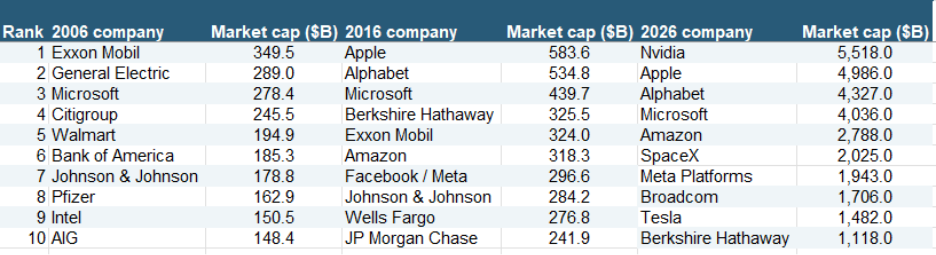 Source: 24/7 Wall St
Twenty years ago, energy companies, financial institutions, and industrial conglomerates dominated the market. Exxon Mobil held the top position, followed by Microsoft, Citigroup, Bank of America, and General Electric. By 2016, the landscape had changed considerably. Apple, Alphabet (Google), and Microsoft occupied the top three positions, reflecting the growing importance of smartphones, internet advertising, and software. Today, technology's dominance is even more pronounced, with Nvidia leading the way and AI playing an increasingly important role in the valuations of many of the market's largest companies.
The point isn't that today's market leaders are destined to stumble. Some may continue to prosper for decades. But identifying which companies will dominate in the future is extraordinarily difficult.
Another important distinction worth considering: Identifying revolutionary technology isn't necessarily the same as identifying a successful investment. The internet boom of the late 90’s did indeed transform the world, arguably exceeding even the most optimistic expectations. Yet many of the companies that attracted enormous investor enthusiasm ultimately disappointed, while others that weren't initially recognized as industry leaders became extraordinarily successful. AI could follow a similar path. The technology may fulfill its tremendous promise, but that doesn't mean every company associated with it will generate equally impressive investment returns. And even great companies can prove to be disappointing investments if investors pay too much for their future growth.
What Does This Mean for Investors? One of the great strengths of the American economy is its capacity for innovation, competition, and reinvention. Rather than chasing returns or attempting to predict which companies will dominate the next decade, we believe investors are better off maintaining diversified portfolios that allow them to participate in the growth of businesses and industries as leadership changes. Diversification doesn't mean avoiding today's winners, it means recognizing that it’s impossible to know with certainty tomorrow's winners. After all, the next Nvidia may already be in the stock market today - we just don't know which company it is.
Inflation Remains Stubbornly Still High: September’s inflation numbers were released this week, and suggest inflation remains stubbornly elevated. Overall prices rose 0.6%, and core prices (excluding the more volatile food and energy categories) rose 0.3%. Over the last 12 months, overall prices are up 3.7%, well above the Federal Reserve’s target of 2.0%.
Energy prices were a major contributor, particularly fuel oil, which has surged 74.2% over the past year. That’s especially painful for many households in Maine and New Hampshire that rely on heating oil as colder weather approaches.
Economists are increasingly concerned that after five years of elevated inflation, expectations for continued price increases could become entrenched. Workers will demand higher wages to keep pace with rising costs, while businesses raise prices to offset higher expenses, potentially creating a self-reinforcing cycle.
Federal Reserve officials meet later this month to decide whether to raise short-term rates, or hold steady, and the latest inflation figures will undoubtedly weigh heavily on their decision. WSJ Bureau of Labor Statistics - CPI
Financial Planning/Investment Strategy Corner:
Are Retirees Spending Too Little? After decades of working, saving, and investing for retirement, you might think the biggest challenge is making your money last. But for many retirees, the opposite problem exists: they’re reluctant to spend the wealth they’ve accumulated. According to the Employee Benefit Research Institute, retirees with more than $500,000 in savings had spent a median of just 12% of their original savings after 20 years of retirement – meaning their balances barely budged. Other research suggests that retirees may be spending as much as 53% less than they could reasonably afford.
The reasons for underspending vary from it being hard to break lifetime habits of frugality, to fears of running out of money due to unknowns like healthcare spending, inflation, market downturns, etc. This is where financial planning can make a big difference. Understanding how much you can comfortably spend, including accounting for some future uncertainties, can provide the confidence needed to enjoy the wealth you’ve worked so hard to accumulate. The goal is to enjoy your best life from what you saved, so go ahead and spend what your financial plan allows! The Atlantic
Social Security COLA: The Social Security Administration announced this week that the cost of living adjustment (COLA) will increase 3.6% for 2027. The COLA is the annual inflation adjustment to help beneficiaries keep up with inflation. This is the largest increase since 2023. CNBC
Quick Takes:
- China’s export markets may be booming, but it sounds like they have other looming problems, including a crisis of confidence in their younger generation: WSJ
- Kindness can be contagious (give it a try!): Axios
- Are all compostable plastics actually compostable at home (the Smith compost bin would also provide this answer)? Sustainable America
- Flu season is approaching – how to protect yourself now: AP News
There Are “Superagers” Amongst Us! What does it take to remain physically and mentally sharp well into your 80s and beyond? There is a growing interest in these “superagers” who maintain the physical and cognitive abilities of someone much younger. There is even a Super Age Games, which is a competition measuring strength, balance, endurance, and mental agility to assess how well participants are aging. While researchers are still learning what contributes to exceptional longevity, regular exercise, mental stimulation, and strong social connections appear particularly important. The takeaway? Start building these habits now! After all, living longer is great, but living healthier, more active, and independent lives is even better. WSJ
“So, Why Are You Here?” Off the Beaten Path in Denmark: I've been fortunate to travel to Europe many times over the years, and while I still enjoy visiting its famous museums, castles, and historic landmarks, there's only so much "old stuff" one can see before some of the luster wears off. I've often found that venturing off the beaten path offers a better glimpse into the local culture and occasionally leads to some wonderful surprises.
On our recent trip to Denmark, Wendi, some friends, and I stayed in Nyborg, a delightful town about two hours west of Copenhagen. We enjoyed strolling its pedestrian streets, eating wonderful meals, having interesting conversations with locals, and being asked “So, why are you here?”
One day, while driving toward the coast, we stumbled upon a large estate that caught our attention. With few visitors and little signage, we weren't quite sure what we'd found. Just as we were about to leave, we opened the door to a small building and discovered something extraordinary: a collection of more than 10,000 artifacts dating back to the Stone, Bronze, and Iron Ages!
The collection included stone axes, hammers, projectile points, ironwork, fossils, and replicas of ancient gold jewelry. We later learned that the estate, called Broholm castle, had been there for centuries. About 175 years ago, workers discovered ancient gold jewelry while plowing the fields, sparking the estate owner's interest in archaeology. He eventually became an accomplished amateur archaeologist, uncovering thousands of artifacts on the estate and surrounding land.
What amazed me most was that this incredible collection was tucked away in a relatively unmarked building, and we had the entire place to ourselves! The photo below shows just a small portion of the exhibit, with countless additional artifacts stored away for lack of display space.
It was a wonderful reminder that some of travel's greatest treasures aren't found at the famous attractions, but in the unexpected places we discover along the way, where the locals ask you – “So, why are you here?” 😊 Broholm Estate — Wikipedia Visit Nyborg

Quote: “Travel isn’t always pretty. It isn’t always comfortable. Sometimes it hurts, it even breaks your heart. But that’s okay. The journey changes you; it should change you. It leaves marks on your memory, on your consciousness, on your heart, and on your body. You take something with you. Hopefully, you leave something good behind.” Anthony Bourdain
Thank you for reading RSWA Financial Advisor Insights! We welcome feedback, and please forward this to a friend! Be well, take care, and stay safe!