The Federal Reserve Takes Center Stage
Warsh set to become next Federal Reserve Chair
With the Department of Justice’s dismissal of the criminal investigation into Jerome Powell, the conclusion of the vetting session from the Senate Banking Committee and their subsequent approval, Warsh’s nomination now goes to the full-Senate for one additional vote. Kevin Warsh needs a simple majority, 51 votes, to become the next Fed Chair. All indications are this is all but guaranteed (famous last words). Current Fed Chair Jerome Powell’s term as Chair ends May 15th, and I would assume the full-senate vote would come in the next week or so.
What this means
The dual mandate of price stability and maximum employment of the Federal Reserve doesn’t change when the Fed Chair changes. However, what may change are the tools implemented to achieve their dual mandate (which often compete with one another).
Kevin Warsh is seen to many as a well-spoken, convincing figure with decades of experience in the financial industry. At the same time, he has promised to chart a path that is sharply different from recent central bank actions, seeking a “regime change” on how inflation is forecasted, outdated economic models, communication frequency with the press and public, etc. One thing he did reiterate (not like he would say otherwise), is the paramount importance of Fed independence. Warsh Pledges Independence at Fed Hearing - WSJ
Federal Open Market Committee (FOMC) keeps rates steady
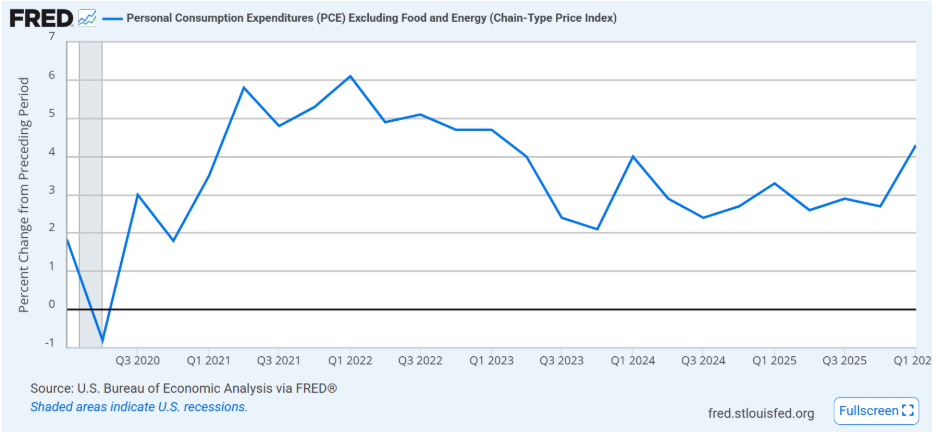
In Jerome Powell’s last FOMC meeting as Fed Chair, the Committee voted to keep the fed funds rate in a range of 3.50%-3.75%, albeit with 4 of the 12 voting members dissenting. The main reason cited for holding rates steady was the ongoing uncertainty related to the Iran war and its subsequent impact on inflation. The Fed’s preferred inflation measure, core personal consumption expenditure (PCE), continues to trend in the wrong direction. Over the last several quarters, core PCE has been hovering north of 3%, well above the Fed’s 2% target. Below is a chart of the percentage change in core PCE from the preceding quarter since COVID:
Financial Planning/Investment Strategy Corner
One of the most frequent questions our client’s ask us is “What percentage of my portfolio can I withdrawal each year without running out of money?” One that would allow their lifestyle to be maintained without completely depleting their portfolio. The general rule of thumb is to add up the total value of your portfolio => take 4% of that number annually => adjust the dollar amount for inflation each year thereafter (this 4% rule was tested assuming a 50% stock/50% bond portfolio). There have been numerous studies/analysis done since the 4% rule became mainstream in the 1990’s, with many citing 4% as too conservative. As with any rule of thumb, this does not mean this is applicable to your retirement situation. Every client is unique in their risk tolerance, retirement lifestyle, portfolio size, income needs, health situation, legacy planning objectives etc. However, most retirees often look at “front-loading” their retirement, maximizing their travel and spending in the beginning years of retirement (expecting to be healthiest during the first several years), decreasing travel and other discretionary expenses as they age. There was an interesting study done by Morningstar addressing this scenario, and what a safe initial withdrawal rate would be for someone wanting to “front-load” their retirement. Again, there are numerous variables at play, but their findings: an approximate 5.5% initial withdrawal rate. For more detail on the nuances of the study and various asset allocations and assumptions used - Strategies for Boosting Retirement Spending: How Advisors Can Maximize Client Outcomes (Safely) | Morningstar
Cybersecurity Strategy Corner:
By Wendi Smith
Tips for using Public Wi-Fi
With warmer weather coming, Wi-Fi hotspots are a convenient way to connect to the internet while on the go. 7-useful-tips-for-anyone-connecting-to-public-wi-fi Typically, you don’t need to enter any sort of verification before accessing the Wi-Fi network, or the Wi-Fi password is publicly posted for all to see. When most of us think of ‘Public Wi-Fi’ we think of our local coffee shop or public places such as airports and restaurants, but even hotel Wi-Fi is considered public. Basically, anything other than your home network or your office network should be considered a Public Wi-Fi.
So, what are some safe ways to use Public Wi-Fi?
- Create strong passwords and turn on two-factor authentication.
- Make sure your software is up-to-date: computer operating systems, security software, internet browsers, and the latest phone software.
- Turn off “auto-connect” in settings so you control when you join a network, especially in unfamiliar places.
- Verify the network name on posted signage and on your device. Fake Wi-Fi may have a name similar to the local Wi-Fi you're trying to connect to.
- Websites typically use some sort of encryption as well to keep your information safe. Look for the lock symbol or https in the address line.
- If you’re comfortable using technology, you can use a VPN (Virtual Private Network). A VPN encrypts your data, so it can’t easily be read. https://www.nytimes.com/wirecutter/reviews/best-vpn-service
Technology has now become a central part of almost everybody’s daily life. Scammers use our innate trust, good nature, and busy paced lives to trick us. Cybersecurity Strategy Corner is all about using your common sense to identify scammers while finding the best ways to incorporate technology for your needs. Any of us can be fooled by the detailed and elaborate cyber schemes out there. Stay cautiously aware when you are in the cyber world, while still enjoying the convenience of Public Wi-Fi access! https://consumer.ftc.gov/articles/are-public-wi-fi-networks-safe-what-you-need-know Finally, if Public Wi-Fi still makes you uncomfortable, (or if your employer limits Public Wi-Fi usage) you can use your phone as a “hotspot” via cellular service and take a pass on the Public Wi-Fi altogether. 😊
Quick Hits:
- We are in the heart of tree pollen season (and I’m working from TN this week and notice the vast difference from Maine) – here is a state-by-state score for outdoor allergies- The best and worst U.S. states for allergies - HouseFresh
- Mother’s Day is just over a week away. Here are some gift ideas (I’m still working on my mom’s 😊): Thoughtful Gift Mom - 60+ Gift Ideas for 2026
- May is “shoulder season” for many places around the globe, where you can enjoy gorgeous destinations with fewer people and at a lower cost. Here is a list of a few where you can maximize your budget: Where to Travel in May: 17 Dreamy Destinations You'll Love
- Not sure how much weight you put into Zodiac signs – but we are in the season of the Taurus (yours truly) – I find it more accurate than not: Taurus Zodiac Sign: Horoscope, Dates & Personality Traits
Quote: “A mother is she who can take the place of all others but whose place no one else can take." - Cardinal Mermillod
Thank you for reading RSWA Financial Advisor Insights! We welcome feedback, and please forward this to a friend! Be well, take care, and stay safe!