The midterm election has now come and gone. After months of seemingly endless political ads, my family can hopefully get back to watching The Wiggles without being interrupted by political attack ads every five minutes.
With the votes counted, Democrats have taken control of both the House and the Senate, setting up a divided government with President Trump still in the White House. The result likely means more political gridlock over the next two years, with fewer major policy changes making their way through Congress.
But what does that mean for the stock market?
As is usually the case, company earnings and the broader economy matter far more to market performance than the outcome of an election. That said, history offers some encouraging perspective. According to CNBC, dating back to 1982, the S&P 500 has averaged a 13.7% return in the year following midterm elections, finishing higher in 91% of those periods. Historically, returns have been even stronger under divided government, which is the environment we’re likely to see over the next two years.
Of course, history is no guarantee of future results, but it’s a good reminder that political gridlock in Washington doesn’t necessarily translate into trouble for investors. CNBC – Stock Market After Midterm Elections
The Market Is Up, But Is It Getting More Expensive?
The S&P 500 is up approximately 12% year to date, following returns of 26.06%, 24.88%, and 17.78% over the past three years. After a run like that, it’s natural to wonder whether the market is getting expensive. But a closer look beneath the surface tells a different story.
One common way investors evaluate market valuations is through the price-to-earnings (P/E) ratio, which measures how much investors are paying for each dollar of earnings. Think of it like buying eggs. If one carton costs $3 and another costs $4, the $4 carton seems more expensive. But what if the first contains 12 eggs and the second contains 18?
In this example, let’s call it the price-to-egg ratio. The first carton costs $0.25 per egg, while the second costs just $0.22. Despite the higher price tag, the second carton actually offers better value. The same principle applies to the stock market: higher prices don’t necessarily mean higher valuations if earnings are growing even faster.
At the start of the year, the S&P 500 stood around 6,800, compared to approximately 7,600 today. Yet its forward P/E ratio has fallen from 22.0 to 18.7 as earnings expectations have risen relative to prices. In other words, investors are paying less for each dollar of expected earnings despite the market’s rise. Today’s forward P/E ratio is also below the five-year average of 19.8 and the 10-year average of 19.1. FactSet – Earning Insight
The key question is whether earnings growth can continue to meet expectations. While that remains to be seen, today’s valuations suggest the market isn’t as expensive as its recent gains might lead you to believe.
Financial Planning Corner:
Required Minimum Distributions (RMDs) & Qualified Charitable Distributions (QCDs)
As the calendar year draws to a close, now is a smart time to check in on your retirement accounts and confirm your required minimum distributions (RMDs) are taken care of. An RMD is the minimum amount the IRS requires you to withdraw from certain retirement accounts each year. If you were born between 1951 and 1959, your RMDs begin at age 73. If you were born in 1960 or later, they begin at age 75. Whether or not you need the income, these withdrawals aren’t optional, so a little planning now can help you steer clear of unnecessary taxes and penalties.
If you'd like your RMDs to do more good, a Qualified Charitable Distribution (QCD) is worth a look. A QCD lets you send money from your IRA directly to a qualified charity. The distribution is excluded from your taxable income while supporting the causes you care about. Even better, a QCD counts toward your RMD amount, so you can satisfy your requirement and give at the same time. For 2026, you can give up to $111,000 per person this way. You also don't have to wait for RMDs to start, since QCDs are available beginning at age 70½.
Timing matters, though. Your QCD needs to be completed by December 31, and custodians often need time to process these requests, so it’s best to reach out well in advance rather than in the final days of the year. RSWA - Using an IRA QCD: Consider Giving Your IRA RMD to Charity
Quick Hits:
- It’s Restaurant Week in Portsmouth! Check out the participating restaurants and see what’s on their special menus: Go Portsmouth
- I’m a few years late to the party on this one, but I recently watched Music by John Williams on Disney+. It’s pretty amazing to think that one person is behind so many iconic film scores that have become part of our lives Disney+ - Music by John Williams
- More exciting (or terrifying, depending on your perspective) data on how quickly AI continues to advance and improve itself. WSJ - The Smartest People in AI Believe This Is the World’s Most Important Chart
- Greenland: The Next Big Travel Destination? Newly opened airports are making it easier to reach one of the world’s most remote and beautiful destinations. AFAR
IMPACT
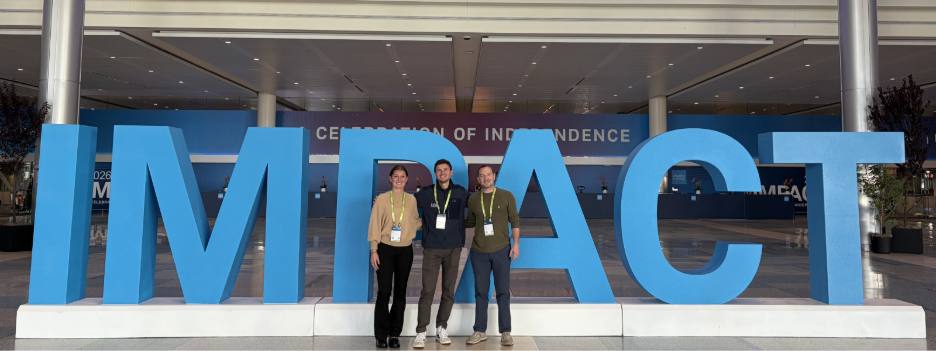
Last week, Wes, Gabby, and I spent time in Boston attending Schwab's annual IMPACT conference, an event designed for independent Registered Investment Advisors (RIAs) like RSWA.
As a small firm, we're always striving to provide our clients with the best service and advice, and we rely on a lot of great resources to help us along the way. Attending IMPACT gives us an opportunity to hear from industry leaders, explore the latest technology, and get a better sense of where the industry is heading.
Being in the same room as 3,400 other advisors, all working toward many of the same goals, was a great reminder that we're part of a much bigger community. It was also a great opportunity to swap ideas, compare notes, and bring a few new ones back home.
Quote: “Our potential is one thing. What we do with it is quite another.” Angela Duckworth
Thank you for reading RSWA Financial Advisor Insights! We welcome feedback, and please forward this to a friend! Be well, take care, and stay safe!