The Federal Reserve met last week and raised interest rates for the first time since 2023. The move was widely anticipated, but it was still significant. All 12 voting members of the Federal Open Market Committee (FOMC) supported the increase. The Fed’s updated projections suggest policymakers now expect rates to remain higher for longer than they did just three months ago.
If you dig a little deeper into what the Fed said last week, there is more to consider. Most notably, Fed officials increased their projections for interest rates going forward. Below is a comparison of the current projections for the Fed funds rate with those from June. The median participant sees essentially no net decline in the federal funds rate between the end of 2026 and the end of 2027—both are 4.1%.
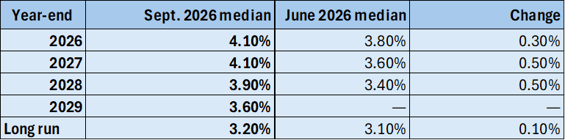
These are median numbers, but the individual dot plots tell an even more interesting story. FOMC participants are much more clustered in their expectations than they were in June—and that cluster has shifted toward higher interest rates. Each dot represents an individual FOMC participant's projection.

For simplicity, the figures show the corresponding target-rate ranges rather than the precise midpoint represented by each dot.
Why the Fed Moved its Projections Higher:
The economic projections help explain the change. The Fed simultaneously raised its growth forecast, lowered its unemployment forecast, and slightly increased its inflation expectations:
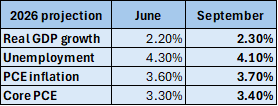
The Fed isn't raising its rate projections because it suddenly expects a recession. Quite the opposite: it now expects slightly stronger economic growth, lower unemployment and somewhat higher inflation. That's a meaningful change from the market narrative earlier this year.
The economic issue we will be watching most closely heading into the fourth quarter is whether higher energy costs begin spreading into the rest of the economy. Right now, core CPI at 2.4% looks relatively benign while headline inflation is being pushed higher by energy. If energy prices stabilize, headline inflation could potentially fall fairly quickly. If elevated energy and producer costs start showing up in core goods and services, the Fed has a more difficult problem.
For now, the message from the Fed is clear: the economy remains resilient, inflation remains a concern, and policymakers expect interest rates to remain higher for longer than they did just a few months ago. Whether that outlook changes will depend largely on where inflation goes from here.
Financial Planning/Investment Strategy Corner:
What is this IRMAA Thing?
If you are on Medicare—or getting close to Medicare age—your tax planning can affect more than just your income tax bill. It can also affect how much you pay for Medicare.
Higher-income Medicare beneficiaries pay an additional premium known as the Income-Related Monthly Adjustment Amount, or IRMAA. IRMAA can increase both Medicare Part B and Part D costs.
What makes IRMAA particularly important for financial planning is the timing. Medicare generally looks back two years when determining whether you will pay IRMAA. That means financial decisions you make in 2026 can generally affect your Medicare premiums in 2028.
How Does IRMAA Work?
IRMAA is based on your Modified Adjusted Gross Income (MAGI). For this purpose, MAGI is generally your Adjusted Gross Income (AGI) plus tax-exempt interest income.
For example, the 2026 Medicare premiums are generally based on income reported on your 2024 federal income tax return. Here is the information for 2026 Medicare premiums and the IRMAA increases.
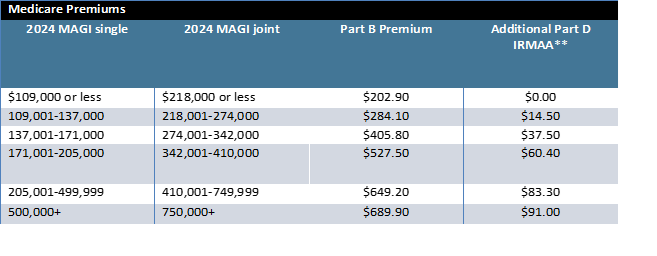
**The Part D amounts shown above are the IRMAA surcharge and are in addition to the premium charged by your Part D plan.
Why Financial Planning Decisions Matter:
Many people assume IRMAA applies only to people who consistently have high incomes. That's not necessarily the case. A single financial transaction can push your income over an IRMAA threshold.
Examples include:
- Roth conversions. Converting $50,000 or $100,000 from a traditional IRA to a Roth IRA increases taxable income and could move you into a higher IRMAA bracket.
- Capital gains. Selling appreciated investments, real estate or another asset can produce a large capital gain that increases MAGI.
- IRA withdrawals. Taking more from a traditional IRA than you normally would can increase income for the year.
- Required Minimum Distributions (RMDs). As RMDs increase over time, they can push income into a higher IRMAA tier.
- Tax-exempt interest. Municipal bond interest may be exempt from federal income tax, but it is generally included in the MAGI calculation used to determine IRMAA.
Crossing a Threshold Can Be Expensive:
IRMAA works in tiers, which means even a relatively small amount of additional income can push you into the next premium level. That doesn't necessarily mean you should avoid a Roth conversion, capital gain or IRA withdrawal. It simply means the additional Medicare cost should be part of the calculation.
Don't Let IRMAA Prevent Good Tax Planning:
It can be tempting to treat an IRMAA threshold as a line that should never be crossed. We don't think that is the best way to approach it. Consider someone with a large traditional IRA who has recently retired.
A Roth conversion might increase Medicare premiums two years later. But the conversion could also reduce future RMDs, move assets into a Roth IRA where qualified withdrawals are generally tax-free, and potentially reduce taxes later in retirement.
The better question isn't simply "How do I avoid IRMAA?" It is "What strategy produces the best overall result?"
What If You Retire and Your Income Drops?
The two-year lookback can create an obvious problem. Suppose you retire in 2026 after earning a high salary. Two years later, Medicare could look at that higher 2026 income when determining your premiums even though your current retirement income is much lower.
Fortunately, Social Security allows beneficiaries to request a new IRMAA determination following certain qualifying life-changing events.
Those events include:
- Marriage
- Divorce or annulment
- Death of a spouse
- Stopping work
- Reducing work
- Loss of income-producing property
- Loss of certain pension income
- Certain employer settlement payment
A beneficiary who qualifies can request a reduction using Form SSA-44.
The lowest Medicare premium isn't necessarily the goal. The goal is to coordinate taxes, investments, retirement distributions, Social Security and Medicare so that today's decisions make sense as part of your overall financial plan.
If you are considering a significant Roth conversion, IRA distribution, investment sale or other financial transaction before year-end, talk with your advisor and tax professional about both the immediate tax consequences and the potential effect on future Medicare premiums.
Quick Hits:
- George Lucas’s Museum: I have never felt the pull to visit LA until now with the new Lucas Museum of Narrative Art opening. I may have to plan a trip! Lucas Museum of Narrative Art
- I will be cooking with apples this weekend. If you are too, here are some ideas: 56 Best Apple Dessert Recipes 50 Best Apple Recipes That Are Perfect for Fall
- We’re closing in on the end of fair season. The Cumberland Fair starts this weekend, with the Fryeburg Fair right behind it: Fryeburg Fair Cumberland Fair
Butterflies and Babies
In my last newsletter, I wrote that I had a monarch caterpillar in its chrysalis. It emerged the day my granddaughter was born. Here are pictures of both the butterfly and Melody, who was born on August 31st. The butterfly quickly flew away; Melody quickly captured everyone’s attention.



And now that I'm officially a grandmother, a few quotes about grandchildren seem appropriate:
- “An hour with your grandchildren can make you feel young again. Anything longer than that, and you start to age quickly.” – Gene Perret
- “Grandchildren are the reward you get for keeping their parent alive.” – Unknown
- “To hold a grandchild is to hold a tiny piece of the future in your hands.” – Unknown
Thank You for Reading
Thank you for being part of the RSWA community and for reading Financial Advisor Insights!
We welcome your feedback — and please share this with a friend or colleague who might enjoy it.
Be well, take care, and stay safe!