Stop me if you’ve heard this one before: inflation continues to be top of mind for both investors and consumers. In fact, I asked AI how often inflation has been a major topic in our weekly newsletter over the past several years. The answer was roughly 50 times since 2021. That highlights both how important inflation has been to investors and clients, and how persistent the issue has remained.
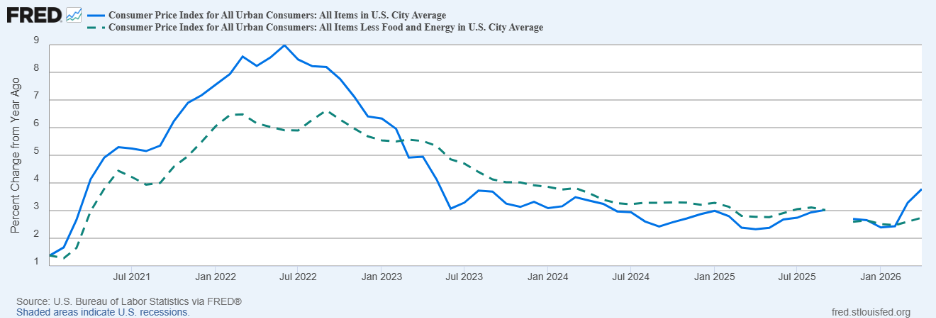
The latest Consumer Price Index (CPI) report showed inflation rising 3.8% year over year in April, up from 3.3% in March and 2.4% in February. Much of the increase was tied to energy prices connected to the ongoing Iran conflict, with gasoline, electricity, and airline fares contributing heavily to the rise. Core CPI, which excludes food and energy, came in at 2.8%. While more encouraging, it still remains above the Federal Reserve’s 2% target. CNBC – Inflation Breakdown For April 2026
Markets have responded by dialing back expectations for near-term interest rate cuts. Treasury yields moved higher following the report (more on that below), reflecting growing concern that inflation may remain sticky throughout 2026. While the broader economy has remained surprisingly resilient, persistently high interest rates continue to pressure consumers and businesses alike. The longer inflation stays elevated, the greater the risk that economic growth gradually slows as borrowing costs remain restrictive.
Chart of the Week:
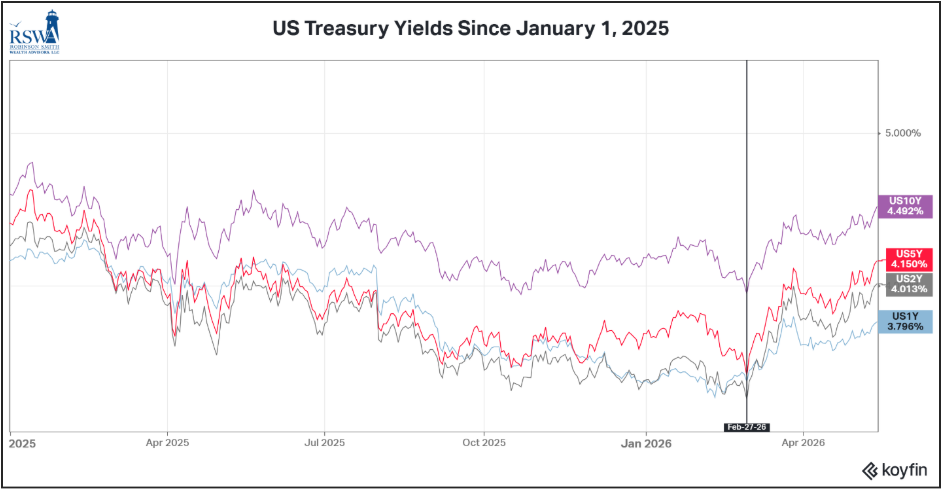
For much of 2025, US treasury yields trended downward as inflation had remained mostly in check, paving the way for the Federal Reserve to continue their rate cutting policies. However, since the start of the conflict with Iran (indicated by the the line in the graph on February 27th – the last trading day before the conflict began), yields have steadily climbed higher as investors anticipate the Fed remaining on hold as inflation ticks higher.
These higher yields impact both borrowers and investors. Interest rates obviously directly impact borrowers as many financing options such as mortgages, car loans, HELOCs, and other forms of debt are directly tied to movements in US Treasuries.
Bond investors are also affected. Bond prices move inversely with interest rates, meaning that when rates rise, bond values fall, and when rates decline, bond prices rise. While 2025 was a strong year for fixed income markets due to steadily falling rates, 2026 has introduced more headwinds for bond returns as yields have moved higher.
Financial Planning Corner:
Giving Close to Home: The Role of Community Foundations
We have written previously about strategies that can help maximize charitable giving, including Donor-Advised Funds and Qualified Charitable Distributions from IRAs. While these tools can be highly effective from a tax and planning perspective, another meaningful way to give back is through your local community foundation.
Community foundations can be a powerful way to support the local communities and causes that matter most to you. Unlike direct donations to a single charity, community foundations pool resources from donors across a region and help distribute funding to nonprofits, scholarships, and community initiatives where the need is greatest. They also offer flexibility, allowing donors to support specific organizations or broader causes such as education, healthcare, conservation, or housing.
Organizations such as the New Hampshire Charitable Foundation and the Maine Community Foundation work closely with local nonprofits and communities throughout Northern New England to maximize the impact of charitable giving. For individuals and families who want their philanthropy to stay local but may not know exactly where to direct funds, community foundations can provide both guidance and long-term community impact.
Quick Hits:
- The Giro d’Italia (Italy’s version of the Tour de France) is winding its way through Italy. Here are some of the beautiful Italian landscapes the Peloton will be racing through Italia
- 7 ideal destinations for a long weekend on the Atlantic coast WorldAtlas
- If America’s so rich, how’d it get so sad? Derek Thompson
- As I stuff my face with a bagel while writing this, have we achieved “peak bagel”? WSJ
1:59:30
On April 26 at this year’s London Marathon, a barrier once thought impossible was finally broken: a human officially ran a marathon in under two hours. Sabastian Sawe of Kenya finished the 26.2 miles in 1:59:30, shattering the previous world record by more than a minute. For reference, that is a 4:33 pace per mile. Citius Mag - Sub-2! Sabastian Sawe Runs 1:59:30 Marathon World Record In London
What may be even more impressive is that he was not alone. Yomif Kejelcha of Ethiopia also broke the two hour barrier with a time of 1:59:41 in his first ever marathon, which was only good enough for second place on the day.
Advancements in the sport have played a major role in marathon times continuing to fall. Training methods have become far more scientific and data-driven. “Super shoes” entered the scene roughly a decade ago, using carbon plates and specialized foam technology to essentially strap springs to your feet. Nutrition and fueling strategies before, during, and after races have also advanced rapidly and are now a critical piece of performance at the highest level.
While this may have been the first official sub-two-hour marathon, it almost certainly will not be the last. Much like Roger Bannister breaking the four-minute mile in 1954, once a barrier that once seemed impossible is broken, perceptions change, and the floodgates tend to open.
Quote: “The body achieves what the mind believes.” – Napoleon Hill
Thank you for reading RSWA Financial Advisor Insights! We welcome feedback, and please forward this to a friend! Be well, take care, and stay safe!