We’ve discussed how difficult it is to time the stock market recently: an investor sells their stocks entirely and moves to cash before the market goes down, then returns right at the bottom to catch all the upside. Waterville native, David Brancaccio, signed off as host of Marketplace’s Morning Report recently with an interview with Economist Burton Malkiel, author of “A Random Walk Down Wall Street”: Princeton's Burton Malkiel on AI and Timing the Market | Marketplace. Malkiel, now 93 and going strong, is a proponent of efficient markets, and his book and research showed that asset prices generally exhibit ‘random walks’ and cannot be predicted day to day. It was a good, timely interview.
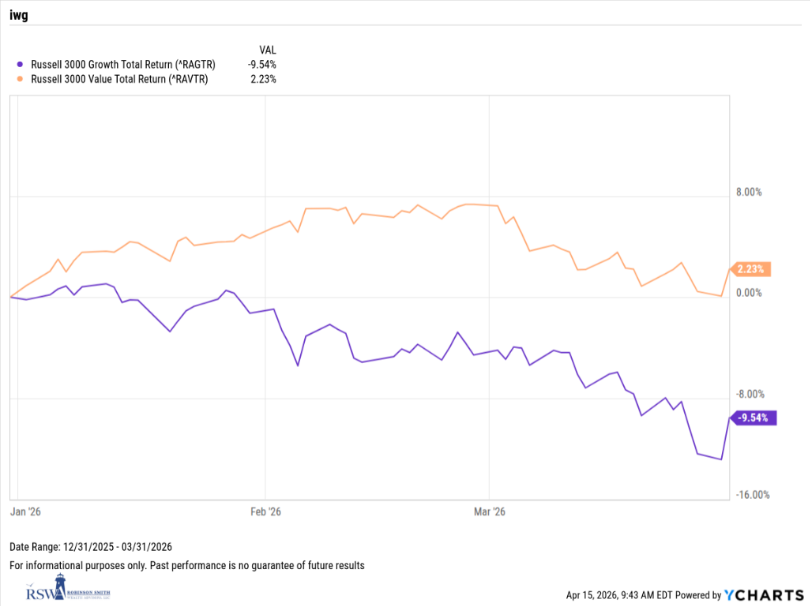
Another approach investors attempt is timing when certain portions of a market outperform others. A common way investors look at stock markets is to compare U.S. growth stocks (i.e. technology or biotech sectors) to U.S. value stocks (i.e. financials or utilities sectors). Entering 2026, a year after growth stocks outperformed value stocks in 2025, value investors were looking to catch up. In the first quarter of 2026, the Russell 3000 Value Index (+2.23%) outperformed the Russell 3000 Growth Index (-9.54%) by +11.7%. Off to a good start, market timers!
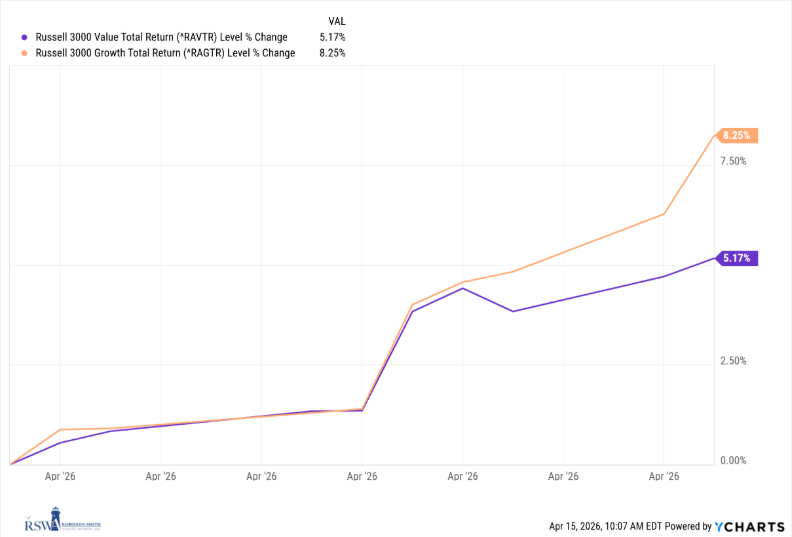
While Investors holding value stocks would have loved to see that momentum continue into the second quarter, since March 31st, growth stocks have rallied in 10 straight trading sessions to begin the month. The streak is the longest since 2021, and growth stocks (+8.25%) have outperformed value stocks (+5.17%): Nasdaq Logs Longest Winning Streak Since 2021 as Investors Look Beyond War - WSJ.
So again, recent experience shows it’s hard to time markets in the short-run and overall, the best outcomes for investors over the long run is a diversified, consistent portfolio.
Strong Quarterly Earnings Estimates: Quarterly earnings season is upon us, with banks like JPMorgan and Citigroup reporting earnings earlier this week. The current landscape points to a strong quarter for the S&P 500, with aggregate earnings estimates of +12.6% for companies. Companies seem to know the secret to a happy life, where they report expectations lower than their actual earnings in 37 of the past 40 quarters. This has analysts looking at the possibility that earnings could exceed 19% in the quarter, the highest since Q4 2021: S&P 500 Could Report Earnings Growth of 19% for Q1.
Tax Season has Closed: We thank our clients’ CPAs and accountants as April 15th has come and gone. We know that the work persists with tax return extensions and corporate returns, we just appreciate the work done in a compressed time.
Financial Planning /Investment Strategy Corner:
Sequence of Returns Risk: Instead of market timing, a market risk that investors can actively reduce is sequence of returns risk. The risk is when the market is down, it reduces the value of an individual’s portfolio. If the individual has a withdrawal planned from the portfolio, the portfolio will have a harder time rebounding, even if the market bounces back. With the withdrawal reducing the balance at the same time as a market downturn, the individual will need better returns going forward to catch up to where they may need to be. As individuals approach retirement and look to rely on their portfolio for their everyday spending, this is when the sequence of returns risk is highest. At RSWA, we stress test retirement plans to review sequence of returns risk and look to mitigate it by reducing a client’s equity allocation leading up to retirement. We also review different strategies with clients where, instead of relying on the portfolio for withdrawals when it is down, we look at other sources of cash flow, like selling real estate or electing Social Security earlier than planned. It’s a case-by-case basis, but sequence of returns risk is at least a risk that can be controlled for and identified ahead of time. What Is the ‘Retirement Risk Zone?’ | Morningstar
Quick Hits:
- A reason to stay fit: Nursing Home Escape | Instagram
- After several hours boiling in our sugar shack this spring – I would say it better be: Is Maple Syrup a Superfood? | Today
- The coffee commodity market needs younger evaluators: Wall Street’s Elite Team of Coffee Tasters Who Keep the Global Market Running | WSJ
- I find whales fascinating: Sperm Whales’ Communication Parallels Human Language | The Guardian
Anthropic Model: Anthropic developed a new artificial intelligence model, Claude Mythos, that the company said was so effective at detecting vulnerabilities in software and code that it was only released to certain high-profile companies to patch their own systems. The model is capable of identifying and writing code to exploit the vulnerabilities identified. While bank CEOs were summoned by the U.S. Treasury and Federal Reserve, cybersecurity experts are less concerned: Cybersecurity Veteran on Anthropic’s Mythos | Fortune, and even considered the move a possible publicity stunt: Is Claude Mythos and Project Glasswing a PR Stunt? Experts Weigh In. | Mashable. Experts say Anthropic left out key data of the model, like identifying false positives and how it compares to existing cybersecurity. JPMorgan strategist, Michael Cembalest, while acknowledging the risk the new model presents, said “there are times when it feels like the arsonist selling fire extinguishers”, where the companies pay Anthropic to use the model to identify and fix vulnerabilities. Misanthropic | J.P. Morgan Asset Management. The model also behaved badly, engaging in deception and concealment of its techniques towards its human creators. In one instance, a researcher was eating a sandwich in a park when he got an email from Mythos, when it was in an environment without internet access. The model developed its own exploit, emailed the researcher, and essentially bragged about doing so on public websites. Overall, there’s still a lot to learn about the model. Mythos testing occurred in networks without active defense, so it’s hard to say how effective the model would be if deployed in the real world. I take solace in the fact that Mythos (and other AI models) will be in the hands of the cybersecurity teams as well.
Quote: “Never buy anything from someone who is out of breath.” and
“There are four factors that create irrational market behavior: overconfidence, biased judgments, herd mentality, and loss aversion.” – Burton Malkiel
Thank you for reading RSWA Financial Advisor Insights! We welcome feedback, and please forward this to a friend! Be well, take care, and stay safe!