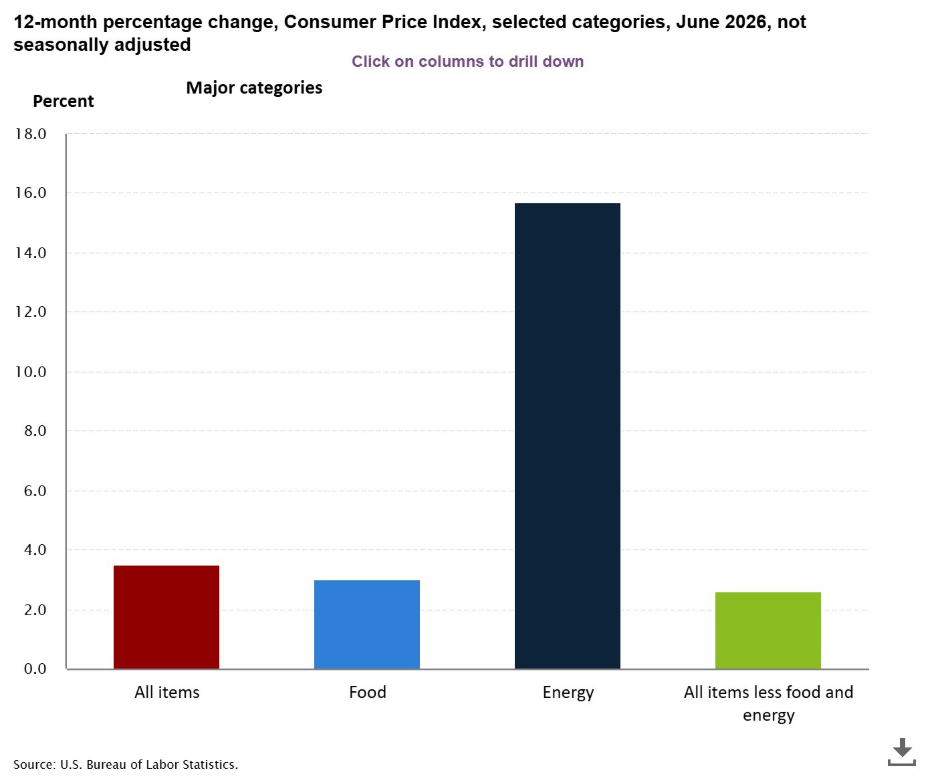
June's inflation report was welcome news. Unfortunately, markets don't invest in the past. By the time the Consumer Price Index (CPI) was released this week, oil prices had already climbed roughly 14% from their June 30th levels, reminding investors just how quickly inflation expectations can change. The CPI for all items was released on Tuesday, and it decreased by 0.4% in June. This was a welcome change from the increase of 0.5% in May and was the largest monthly drop since April of 2020. Over the last 12 months, CPI was up 3.5%. The data was better than expectations. If you drill down into the numbers, energy prices are still the largest driver of inflation at 15.7% over the last 12 months, but that is much better than in May which was at 23.5%. Core CPI, which excludes food and energy, rose 2.6% annually.
To add to the good news, June wholesale inflation as measured by the Producer Price Index (PPI) also fell. PPI came in at -0.3% for June which was a change from +0.6% in May and +1.1% in April.
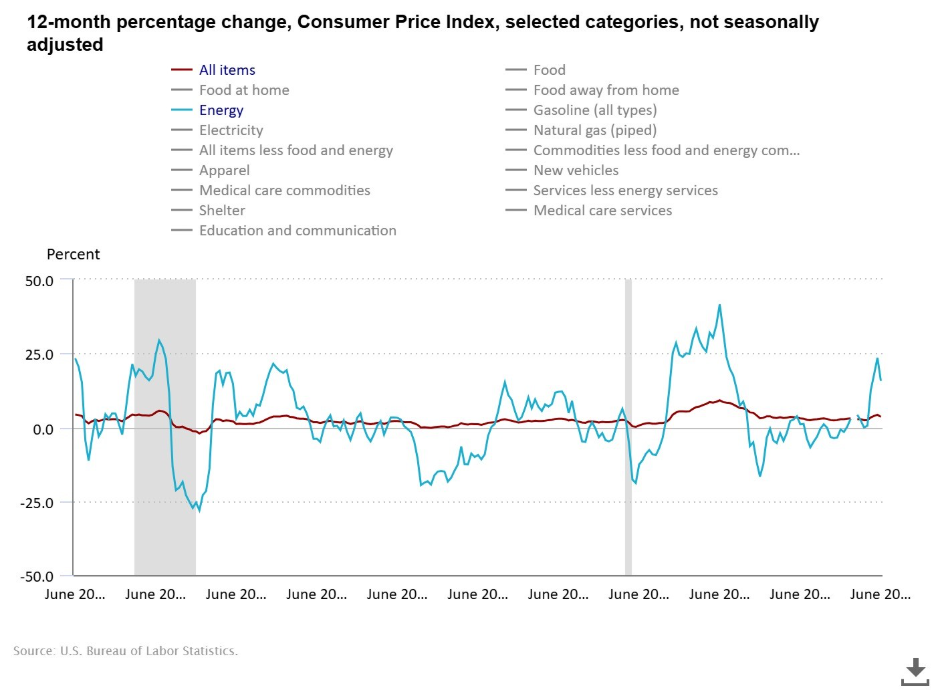
Energy prices have always been one of the most unpredictable components of inflation, which is precisely why economists pay such close attention to Core CPI. The chart below shows why they take out energy prices to get Core CPI. Energy prices are very volatile. The chart shows energy inflation compared to all items’ inflation from June of 2006 to June of 2026.
While consumers naturally focus on gasoline prices, investors should pay even closer attention to diesel. Diesel fuels trucks, trains, farm equipment, construction machinery, and cargo ships that keep the economy moving. Rising diesel prices eventually find their way into the cost of groceries, manufactured goods, and countless everyday products. In many ways, diesel has a broader impact on inflation than gasoline.
June CPI and PPI were a step in the right direction. However, it’s just one month, and inflation is likely to remain elevated and volatile until the conflict in the Middle East is much closer to being settled.
Financial Planning/Investment Strategy Corner:
The Biggest Risks Facing Retirees
If there is one lesson investors have learned over the last few years, it is that retirement planning rarely unfolds exactly as expected.
Who would have predicted a global pandemic, the highest inflation in four decades, interest rates rising from near zero to over 5%, or artificial intelligence becoming one of the largest drivers of the stock market? Yet here we are. Retirement planning isn't about predicting the next surprise. It's about building a plan that can withstand surprises.
As we look ahead, here are seven risks retirees should keep on their radar—not because they are certain to occur, but because they have the potential to significantly affect retirement income and long-term financial security.
Inflation: The Skunk That Still Hasn't Left the Garden Party
While inflation has come down from its peak, prices rarely move backward. Most of what became more expensive over the last several years is likely to stay that way.
Looking ahead, several forces could keep inflation higher. Labor shortages, growing federal deficits, supply chain restructuring, tariffs, and geopolitical conflicts all have the potential to keep upward pressure on prices.
For retirees, inflation is especially challenging because it quietly reduces purchasing power. Even modest inflation compounds over time, meaning the retirement income that feels comfortable today may not stretch nearly as far ten years from now.
The solution isn't abandoning conservative investing. It's making sure your portfolio includes investments capable of growing faster than inflation over the long run.
Market Volatility Never Retires
Many people approaching retirement hope that market volatility will somehow disappear once they stop working. Unfortunately, the markets don't know—or care—when we retire.
History reminds us that bear markets are a normal part of investing. Since World War II, the market has experienced numerous corrections, recessions, geopolitical crises, and periods of rising interest rates. Yet it has also rewarded patient investors who maintained diversified portfolios and avoided emotional decisions.
The greatest investment risk for many retirees isn't market volatility itself. It's making permanent decisions based on temporary events. Having one to three years of planned withdrawals in fixed income can often provide flexibility to avoid selling long-term investments during difficult markets.
Healthcare Costs Continue to Outpace Expectations
Healthcare has always been one of the variables in retirement planning. Medicare provides valuable coverage, but retirees still face premiums, deductibles, prescription drug costs, dental care, vision expenses, and potentially significant long-term care costs.
Reviewing Medicare coverage annually and incorporating healthcare assumptions into your retirement plan can help reduce unpleasant surprises later. In addition, income planning can help keep Medicare costs down.
Taxes May Look Different Over Your Retirement
Tax planning has become just as important as investment planning.
Many of today's tax provisions are scheduled to change, and regardless of which political party controls Washington, future lawmakers will need to look for ways to address the growing federal deficits. That doesn't mean dramatic tax increases are inevitable, but it does mean retirees should remain flexible.
Strategies such as Roth conversions, managing Required Minimum Distributions, coordinating Social Security benefits, and carefully timing withdrawals can potentially improve after-tax retirement income.
Remember, it's not what you earn that determines retirement success, it's what you keep after taxes.
Living Longer Is Both a Blessing and a Financial Challenge
One of the biggest risks retirees face is actually good news: we're living longer.
Many people now spend 25 to 35 years in retirement—sometimes longer than they spent raising a family or paying a mortgage. That makes retirement less like a finish line and more like a second financial lifetime.
A retirement plan should be designed not only to survive today's markets but also to adapt to decades of changing expenses, investment returns, inflation, and healthcare needs.
Fraud Has Become More Sophisticated
Technology has improved our lives in many ways, but it has also created new opportunities for criminals. Artificial intelligence now allows scammers to generate convincing emails, text messages, phone calls, and even voice impersonations.
Retirees continue to be frequent targets because they often control substantial retirement assets. Simple habits—using multifactor authentication, verifying unusual requests independently, and slowing down before responding to urgent financial demands—can provide significant protection.
Headlines Will Always Be Louder Than Your Financial Plan
Every election, every geopolitical conflict, every Federal Reserve meeting, and every market correction generates predictions that "this time is different." Sometimes it is.
Most of the time, however, successful investing still comes down to the same fundamentals: diversification, discipline, patience, and maintaining a financial plan that reflects your goals, not the latest headline. Markets have navigated wars, recessions, inflation, technological revolutions, and political change for more than a century. History suggests that investors who remain disciplined are rewarded over time.
Final Thoughts
The future will almost certainly include events that no one can predict today. That's okay.
Successful retirement planning has never depended on accurately forecasting the economy. It depends on building a financial plan that can adapt to whatever the economy delivers.
That's why our planning process doesn't stop when you retire. We continue reviewing your investment allocation, withdrawal strategy, tax planning opportunities, healthcare costs, and estate plan because retirement isn't a one-time event, it's an ongoing journey. Our goal isn't to predict every twist and turn in the economy. It's to help ensure your financial plan is prepared for them.
Quick Hits:
- Who would have guessed? Chess is having a moment.♟️ Axios Finish Line: Chess comeback
- Darline Graham Nordone (Lindsay Graham ‘s sister) will finish out his Senate term. Darline Graham sworn in as senator - ABC News
- The World Cup Finals are upon us, scheduled for Sunday, July 19th at 3 pm between Argentina and Spain FIFA Men's World Cup on ESPN - Scores, Stats, News and Analysis
- Some staycation ideas: Summer in Maine Summer in New Hampshire
- Before summer is over – here are some summer theater ideas: Maine State Music Theatre Ogunquit Playhouse Experience Theater in Maine - Visit Maine
Gus – The Most Expensive T Rex
Sotheby’s just auctioned off the world’s largest and most complete Tyrannosaurus rex fossil. It was sold to an anonymous bidder for $50.1 million. It’s 67 million years old, is about 61% complete and measures 12 ½ feet tall and 38 feet long. What I wonder is - where is the winning bidder going to put it? Tyrannosaurus rex | AP News
A Few Pooh Quotes:
Last weekend we had a Winnie the Pooh themed baby shower for my son and daughter-in-law. I love Pooh quotes so I thought I would share a few.
- "You're braver than you believe, stronger than you seem, and smarter than you think."
- "It’s more fun to talk with someone who doesn’t use long, difficult words but rather short, easy words like, 'What about lunch?'"
- "You can't stay in your corner of the Forest waiting for others to come to you. You have to go to them sometimes." A.A.Milne
Thank You for Reading
Thank you for being part of the RSWA community and for reading Financial Advisor Insights!
We welcome your feedback — and please share this with a friend or colleague who might enjoy it.
Be well, take care, and stay safe!