Stock markets tend to take up a lot of headlines, but bond markets are an integral part of the overall market and are larger than stock markets, around 15% larger. Bond investors are sometimes referred to as the ‘adults in the room’ as debt markets tend to be more math based, as bonds carry fixed maturities and coupons, and bond managers look to avoid bankruptcies and defaults. Artificial intelligence (AI) companies are tasked to change a lot of things in the economy and day-to-day life, but to date, they are changing the bond market and, in turn, their company’s balance sheets. AI projects, like data centers, are capital intensive and expensive. Hyperscalers, companies like Microsoft, NVIDIA, META, Amazon, and Oracle, are leading the build out. These companies have strong operating cash flows, but the cost of these projects is requiring them to issue more stock, like Google, or go to the debt markets to finance the projects. Year to date in 2026, nearly 15% of investment-grade bond issuance is linked to hyperscalers: Big Tech's $182 Billion AI Debt Spree | Yahoo Finance.
Oracle’s debt was recently downgraded by S&P Global to BBB- from BBB, one notch above junk or high yield. S&P cited Oracle’s “weaker free cash flow” and a cautious overall view of the AI infrastructure industry due to “rising capital expenditures and an uncertain path to profitability.” Oracle Corp. Downgraded To 'BBB-/A-3' From 'BBB/A | S&P Global Ratings
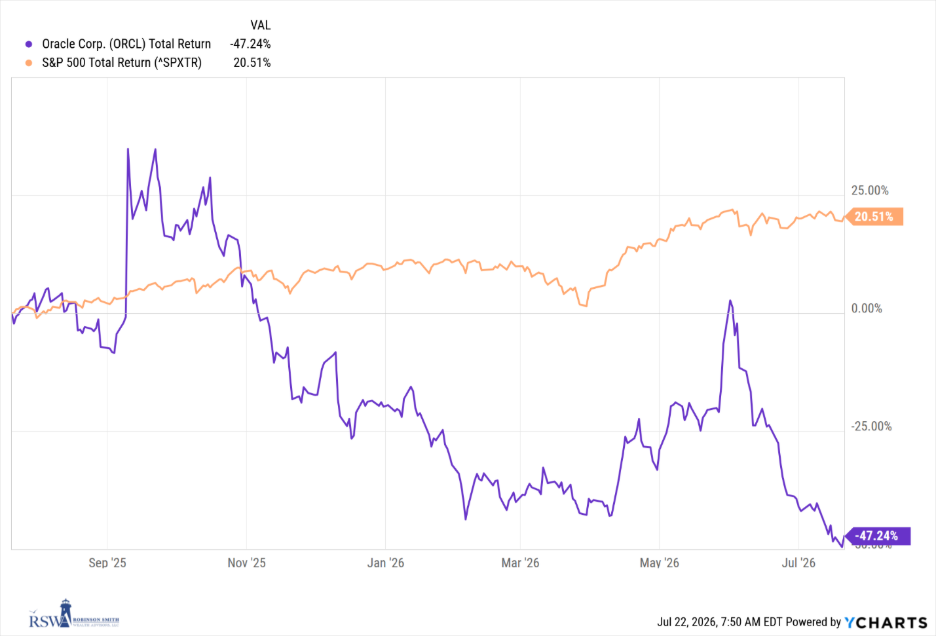
Oracle’s stock has been punished as well, down 47.2% in the past year, with the S&P 500 up 20.5%:
One other measure of debt markets is the demand for each new bond offering, called the cover ratio. In February 2026, cover ratios were nearly 5x for hyperscalers but are now down to 2x: Cover Ratios for Hyperscaler Bonds Declining | The Daily Spark. This means for every dollar of debt issued in February, five investors were willing to buy the bonds; now there are two. This may result in bond investors demanding higher yields from hyperscalers due to the increased uncertainty around the AI buildout.
Financial Planning/Investment Strategy Corner:
Investor Return Gap: Morningstar, known for its extensive coverage and comparison of mutual funds and other investments, reviews fund flows to gauge investment behavior and actual investor returns. Unfortunately for investors (individuals, fund managers, and financial advisors included), we all operate with biases that may impact investment returns. One finding is that investors tend to chase investment returns: My Fund Outperformed. My Return Still Lagged. Come Again? | Morningstar. Morningstar’s finding was that if an actively managed mutual fund outperformed, that would be when investors added money. When the fund underperformed, investors would sell. This is part of what leads to an ‘investor return gap’: The More Investors Traded, the Less Their Average Dollar Made | Morningstar. Morningstar estimates that as of December 31st, 2024, U.S. mutual funds and ETFs earned 8.2% annualized over the trailing 10 years, but investors’ actual returns were only 7.0%. 1.2% annualized per year may not sound like a big deal, but an investment of $10,000 over ten years would result in a difference of about $2,300 dollars, an 11.7% difference. The more volatile a fund or investment, the larger the return gap. Bitcoin (speaking of volatility) ETFs launched in Jan 2024, when the price of Bitcoin was $46,000. On June 30th, 2026, Bitcoin traded at $58,700, up 27.6%, so Bitcoin investors knew what they were doing. Well, Morningstar estimates the original cohort of Bitcoin ETFs lost an annualized 5.8% in that period. When Bitcoin traded above $100,000, investors piled in and added more, then sold when prices dropped: The Mind Game That Investors Can’t Stop Playing - WSJ. To avoid this, we encourage investors (and ourselves as advisors) to:
- Keep a consistent investment approach and asset allocation
- Evaluate your investments over long periods of time versus short
- Rebalance systematically and purposefully
- Maintain positions through volatility
Quick Hits:
- This week, coffee is good for you: Up to 5 cups of coffee per day may potentially lower heart disease risk, doctors say | ABC News and Study Explores How Coffee May Protect the Liver | Cedars Sinai
- The World Cup was a hit in many ways: The Surprise Economic Boost for World Cup Host Cities | WSJ
- My wife tells me I need to read more fiction, but I couldn’t imagine not reading at all (or not reading to our child, daily): 'Post-literate age': Why fewer Americans are reading for pleasure | PBS News
- Maybe restart your reading with ‘The Odyssey’: Was There Ever an Original Version of 'The Odyssey' | Smithsonian
Rosenbergs: Michael Meeropol was the Chair of my Economics Department at Western New England University. Memory can be an unreliable narrator, but I think he met with my parents and me at orientation as I picked classes for my freshman year. That day I was ‘encouraged’ to sign up for the 8am Monday, Wednesday, Friday Microeconomics class taught by one of the younger, “better” professors. I never missed one of those classes that first semester (I may have missed some other classes). I was one of only a handful of economics majors at Western New England University, and I first took a class with Professor Meeropol my sophomore year, where he became my de facto advisor as I blindly navigated school and picking a career. He was a serious, interesting professor, combative at times but caring with an interest in his students. I feel like I did well in his classes because I did the reading beforehand on the syllabus (sometimes, it’s not that hard). I didn’t know for some time he was one of the Rosenberg boys. Some students knew, and I sort of knew of the story, but in one class he revealed it, talking about it for the first time. After revealing it, he said there was a time that his son was a pretty good track athlete in high school and one of the other parents came up to him and said: “Hey, you’re so and so’s dad.” He said it was probably one of the few times someone knew him for something other than what he was famous for, and it felt nice. This article came out this week in The Atlantic, and a few people shared it with me: The Rosenberg Boys | The Atlantic. I know the story now, but I still only think of him as my professor.
Quote:
“A reader lives a thousand lives before he dies…The man who never reads lives only one.” – George R.R. Martin
Thank you for reading RSWA Financial Advisor Insights! We welcome feedback, and please forward this to a friend! Be well, take care, and stay safe!