At RSWA, we communicate with our clients on an ongoing basis about stock market volatility, comfort level with said volatility, and the fact that the stock market, on average, experiences a correction (defined as a 10% drop from recent highs) once every 1-2 years. Though, that is just an average, and it can occur more frequently in any given year. The S&P 500 hit that mark last week, with other indices experiencing even bigger drawdowns. Here is a chart of four ETF’s that track the major market indices from October 6th (when the S&P hit a record) until last Friday, November 20th:
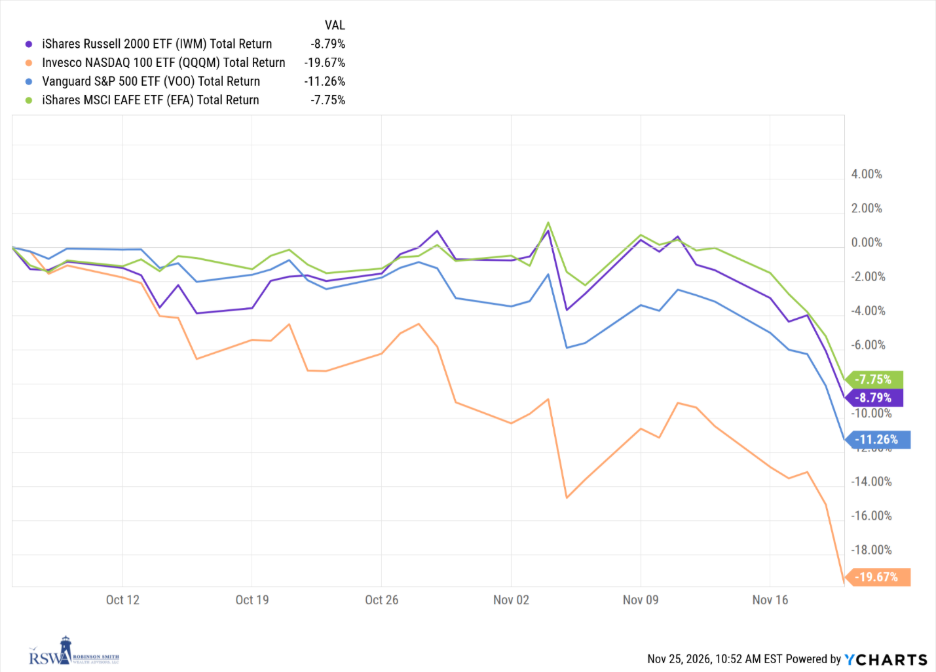
It’s important to understand that the type of volatility we have seen in the last couple months is part of a normal market cycle. It’s helpful to look back at recent history of similar volatility, and how long it took to make new highs (as measured by the S&P):
2026: January 27th-March 30th – drawdown of 9.1% (not quite a technical correction) due to AI concerns and war with Iran; by April 15th (yes, two weeks)– new high
2025: February 19th-April 8th – drawdown of 19% due to Liberation Day; by June 27th – new high
2022: January 3rd-Oct 12th – drawdown of 25% due to aggressive rate hiking cycle by the Federal Reserve/inflation; by January 2024 – new high (so while much longer, the market does recover) S&P 500 Drawdown History: Every Bear Market & Correction Since 1928
The most important takeaway is that wealth creation is about time in the market, not timing the market. Some of the stock markets' best days come within 1-2 weeks of its worst days. Here is one analysis done by Franklin Templeton: Staying invested: The cost of cashing out during a market sell-off | T. Rowe Price. We would love to tell our clients and readers that you can have all the upside without the downside, but that is not reality. During levels of heightened volatility in the stock market, it may be a good time to reassess your risk profile, if the last month or so has made you jittery.
Financial Planning Corner:
During the holiday season, tax-saving strategies may not be top of mind, but as we head into the last month of the year, it is a great time to make sure you are being as tax-efficient as possible. Below are some actions you can take to reduce your tax liability, and additionally, take advantage of current market volatility:
- Maximize contributions to your employer-sponsored retirement plan.
- Maximize contributions to your health savings account (HSA), if eligible. Contributions to your HSA offer a unique opportunity to benefit from a triple-tax advantage - contributions are deductible, growth is tax-free, and withdrawals for qualified healthcare expenses are also tax-free.
- Tax-loss harvesting: I talked about this in my last newsletter Why Losses Present Opportunities, but your advisors at RSWA have been taking advantage of the opportunity the market has presented us.
- With the market volatility, it may be a great time to consider a Roth conversion. While many different variables affect whether a Roth conversion might make sense for you, the ability to convert more shares of your investments from a Traditional IRA to a Roth IRA (while balances are down), and then have those shares in a tax-free bucket for when the market ultimately recovers – is a way to maximize future growth.
Takeaway from Schwab Impact:
I was grateful that David and Tracey allowed Donovan, Gabby and I to spend a couple days at the Schwab Impact conference in Boston last month. One of the more informative sessions I attended was related to Medicare. While not the most exciting topic, it is arguably one of the most important. The speaker, Melinda A. Caughill, a professional Medicare educator with close to two decades of experience helping people navigate the complex world of Medicare, discussed a form I was not aware of – the Medicare Authorized Representative form. Most (including myself) believed that Powers of Attorney grant you the ability to ask any Medicare-related questions on behalf of loved ones – well, not so fast. To assist loved ones with reviewing coverage, filing claims, disputing claims, etc. you must be a Medicare Authorized Representative. Here is a link to the form: Authorization to Disclose Personal Health Information Release Form. It’s important to note that it’s effective for the one-year period after the form is signed/submitted. If anything needs to be amended or updated, a new form is necessary.
Quick Hits:
- Today is Black Friday – hopefully you read this before your shopping begins: The Best Black Friday Deals for 2026
- I’ve yet to go, but think this is the year: Christmas Prelude in Kennebunkport Maine | Christmas Events in Kennebunkport Maine
- If Christmas plans haven’t been made, here are a few ideas: 25 Best Christmas Towns for Holiday Magic in the U.S.
- My Vols have the chance to make the CFP playoff, with only Vanderbilt standing in the way – here is the college football schedule for this holiday weekend: College Football Schedule - 2026 Season - ESPN
Quote: “Among the things you can give and still keep are your word, a smile, and a grateful heart.” – Zig Ziglar
Thank you for reading RSWA Financial Advisor Insights! We welcome feedback, and please forward this to a friend! Be well, take care, and stay safe!