The US economic picture continues to be mixed: inflation is cooling somewhat but hiring and consumer spending have weakened while long-term borrowing costs are rising.
- Inflation: July CPI eased to roughly 3.4% year over year, from 3.5% in June. That's encouraging, but inflation continues to remain well above the Federal Reserve's 2% goal.
- Jobs: July non-farm payrolls fell by about 23,000, while unemployment was around 4.1%. Recent revisions also made previous months' hiring look weaker.
- Consumers: July retail sales dropped 0.6%, substantially weaker than expected. However, some economists argue that Prime Day shifting into June exaggerated July's decline.
- Interest rates: The Fed currently has its benchmark rate at 3.50%–3.75%. There's considerable uncertainty about September: softer inflation/jobs argue against a hike, while persistent inflation pressures argue for one.
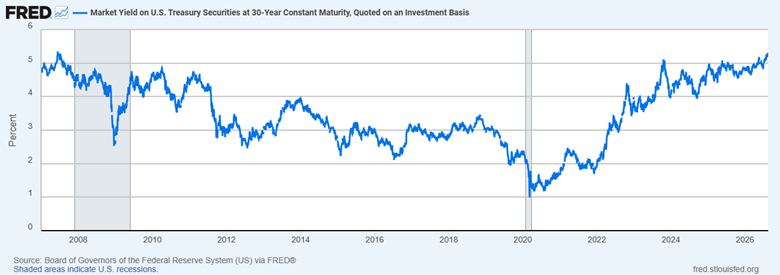
- Bond market: This is arguably the biggest warning sign right now. The 30-year Treasury yield has moved above 5.2%, around its highest level since 2007. Heavy government borrowing, inflation concerns, oil/geopolitical risks, and huge AI-related corporate borrowing are contributing.
- Growth: Forecasts still call for continued growth. Current estimates are for real GDP growth to range between 2.4% and 2.8% for 2026, helped partly by business/AI investment.
The current story is slower hiring, softer consumer spending, somewhat cooler inflation, but still-high inflation and unusually high long-term interest rates. That leaves the Fed in a difficult position: raising rates risks worsening the slowdown, while easing too soon could reignite inflation.
More on the Bond Market
Global bond yields continue to rise, increasing the cost of borrowing. Investors are demanding more compensation for owning long-term government debt because of persistent inflation risk, large federal deficits, higher oil/geopolitical risk, and enormous corporate borrowing—particularly to finance AI infrastructure. 💥 Bond shock
- 🇺🇸 The 30-year Treasury yield hit 5.3%, the highest since June 2007.
- 🇯🇵 Japan's 30-year yield climbed to 4.1%, near a record high.
- 🇪🇺 France's hit 4.9%, the highest since 2008, while Germany's comparable rate hit 3.7%, the highest since the euro-area debt crisis in 2011.
- 🇬🇧 Britain's reached 5.8%, nearing the highest since 1998.
Higher Treasury rates matter because Treasuries are essentially the benchmark interest rate for much of the US financial system. When Treasury yields rise, especially the 10- and 30-year yields, the effects spread well beyond government bonds.
- Mortgages get more expensive, which can slow housing sales and construction.
- Businesses face higher financing costs.
- Stocks face valuation pressure
- The federal government's interest bill rises.
- Savers eventually benefit. Existing bondholders, however, initially lose because bond prices fall when yields rise.
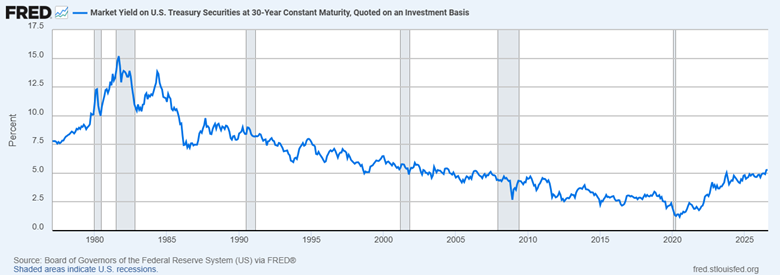
US bond yields have been much higher than they are today, as shown in the chart above. Looking at yields from 1977 to today makes current rates look less unusual. But if you focus on the period since 2007—the last time long-term Treasury yields were around these levels—you can see just how unusual the past decade-plus of very low interest rates was. Those low rates allowed individuals, companies and the federal government to borrow cheaply. At least for the near future, that era appears to be over.
Financial Planning/Investment Strategy Corner:
Getting into the Weeds with Tax Planning: Qualified Vs Ordinary Dividends
A dividend is qualified if:
- It's paid by a US corporation or an eligible foreign corporation.
- You meet the holding period requirement:
- For most common stock, you must have held the shares for more than 60 days during the 121-day period that begins 60 days before the stock's ex-dividend date.
But what about mutual funds and ETFs? When you are not making trading decisions, how can you increase your chances of receiving qualified dividends? Use broad, low-turnover US stock index funds. Funds tracking indexes such as the S&P 500 or total US stock market commonly have a high percentage of qualified dividends. Be more careful with actively managed funds. Higher turnover can sometimes reduce the percentage of distributions receiving favorable tax treatment.
A few things to remember: These tax considerations generally apply to taxable accounts. In tax-deferred accounts such as traditional IRAs and 401(k)s, and tax-free accounts such as Roth IRAs, you don't owe annual taxes on dividends or capital-gains distributions while the money remains in the account. Also, income from bond funds and money markets are taxed as ordinary income.
Quick Hits:
- The fixable smartphone: Fairphone—a Sustainable, Repairable Smartphone| WIRED
- I can’t believe it’s that time but here are some back-to-school ideas: Back-to-School Tips for Families 31 Easy Back-To-School Dinners That Keep Weeknights Stress-Free 45 Back-to-School Lunch Ideas That Kids *Actually* Like
- Here are some ideas for a weekend getaway: 25 Best & Fun Things to Do in New England
- We are smack in the middle of fair season: Maine Association Agricultural Fairs New Hampshire Fairs and Festivals
- I have recently watched two Netflix series based on Harlan Coben books; I Will Find You and Runaway. Both were great and now I find out that Netflix is making 14 of his books into series or movies. I love his books and am enjoying watching them. Every Harlan Coben Show to Watch on Netflix
A Making It Home Update:
In past newsletters, I have written about my involvement in the non-profit Making It Home. I continue to be involved - in fact, I just renewed my board membership for another 3-year term. I am proud of the work we are doing and want to share an update.
We started a little over two years ago, and in that time, we helped over 550 families. Most of our work has been done in the Greater Portland area, but we have traveled to 21 towns, from the Lewiston/Auburn area to Cornish, Sanford and Saco. Many Portland-based non-profits are unable to travel outside of Greater Portland, and we are finding many families in these communities that need our help.
We are now taking the next step in expanding our reach. We are hosting an event to raise funds to purchase a delivery van and to hire our first part-time staff member. Both would allow us to help more families and serve more communities throughout the area.
If you are interested in more information, here is the invitation to our upcoming event. Join us for an evening of celebration and inspiration with Making It Home!
RSWA and the Portland Sea Dogs!
Invites for our Sea Dogs night went out this week. Here is a link if you missed it. Hope you can join us on Thursday, September 10th! It is always a fun time. RSWA & The Portland Sea Dogs 2026
A Few Butterfly Quotes:
I found a monarch caterpillar this week and have it in a mason jar on my kitchen windowsill. As of Wednesday morning, it’s in its chrysalis. If you have never done it – it’s so amazing to watch them.

- We delight in the beauty of the butterfly but rarely admit the changes it has gone through to achieve that beauty. Maya Angelou
- Butterflies…flowers that fly and all but sing. Robert Frost
- The caterpillar does all the work, but the butterfly gets all the publicity. George Carlin 😊
Thank You for Reading
Thank you for being part of the RSWA community and for reading Financial Advisor Insights!
We welcome your feedback — and please share this with a friend or colleague who might enjoy it.
Be well, take care, and stay safe!