Long-time readers of our newsletter and clients of the firm know that we believe in a broadly diversified investment approach as a way to achieve strong long-term outcomes. This view is not based on opinion alone, but on a substantial body of supporting data.
Over the past century, the US stock market has created enormous wealth, but the gains have been highly skewed. In his updated study of nearly 30,000 stocks, Professor Hendrik Bessembinder shows that returns are not evenly distributed. While stocks on average have delivered substantial returns, the typical, or median, stock actually lost money, and nearly all net wealth creation came from a small, concentrated group of companies. SSRN – One Hundred Years in the US Stock Markets
At a high level, US stocks have performed quite well over the past century, delivering roughly 10% annualized returns and generating about $91 trillion in net wealth. It is a strong reminder of why staying invested has historically paid off over time. However, this reflects the market as a whole, often represented by broad indices such as the S&P 500 or the Russell 3000.
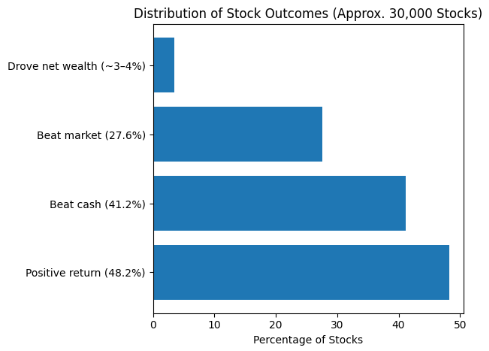
While the overall market has performed well, most individual stocks have not. Of the roughly 30,000 stocks analyzed, only 48.2% generated a positive return. Just 41.2% outperformed cash, as measured by Treasury bills. Even fewer, 27.6%, outperformed the broader market.
A very small group of companies has driven the majority of long-term gains. In fact, just 3 to 4% of stocks accounted for essentially all net wealth creation, with fewer than 50 companies responsible for half of it.
The takeaway:
Consistently identifying those few big winners ahead of time is extremely difficult, and missing even a handful can materially impact long-term results. This is one of the key reasons why diversification, and broad market exposure, play such an important role in portfolios.
Chart of the Week:
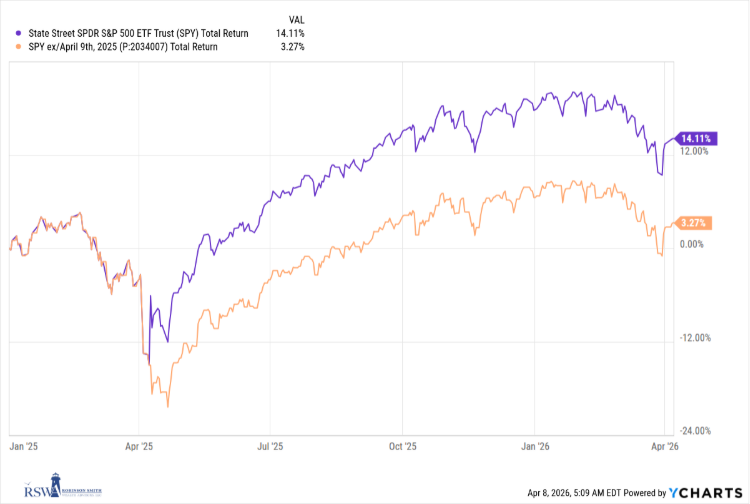
We are now one year removed from last April’s “Liberation Day” tariff announcement, which sent global stocks into a tailspin. This provides a useful opportunity to reflect on how investors have fared since then.
The chart above compares two nearly identical investment experiences, with one key difference. The purple line represents an investor who remained fully invested in the S&P 500 since January 1, 2025. Over the past 15 months, that investor has earned a return of roughly 14%.
The orange line represents an investor who sold on April 8 and missed just one day in the market (April 9). Even with only a single day out of the market, that investor missed a strong rebound and gave up nearly all of the gains achieved by the fully invested portfolio.
Even brief attempts to time the market can have outsized consequences. The market’s strongest days often come unexpectedly, and missing just one can materially impact long-term results. Staying invested and sticking to a disciplined plan is one of the most effective ways to capture the full benefit of market growth.
Financial Planning Corner:
Diversification Beyond the Portfolio: Tax Bracket Management
Sticking with the diversification theme, it can play an important role beyond just investments. Another way we promote diversification is across account types with different tax structures such as pre-tax retirement accounts, Roth accounts, and taxable investments. A balanced mix across these buckets can create meaningful flexibility when it comes to generating income in retirement while keeping taxes low. We often refer to this as “tax bracket management.”
Let’s look at an example. Suppose you need $125,000 in income from your investments in a given year. If all of your assets are in a pre-tax IRA, the full withdrawal would be taxable. Taking $125,000 from the IRA could result in roughly $25,000 in taxes at a 20% effective rate. Alternatively, a diversified mix of account types allows for a more efficient withdrawal strategy. For example, taking $75,000 from a pre-tax IRA, $25,000 from a Roth account, and $25,000 from a taxable account can significantly reduce the overall tax burden. If part of the taxable withdrawal is subject to long-term capital gains at a 15% rate, assuming $10,000 in capital gains for this scenario, total taxes could fall to roughly $16,500. This simple shift can result in meaningful tax savings while delivering the same level of income.
Beyond reducing taxes in a given year, this approach can also help manage income relative to important planning thresholds. For retirees, keeping income below certain levels may help avoid higher Medicare premiums tied to IRMAA surcharges, while also limiting exposure to higher marginal tax brackets. Much like diversification within a portfolio, the goal is not to predict future tax rates, but to build flexibility into the plan, allowing for greater control over how and when income is recognized over time.
Quick Hits:
- Amid global uncertainty, one bright spot: crime in the US is falling sharply WSJ
- How effective is walking for fitness goals? GQ
- Sci-fi vs. real science: Does Project Hail Mary pass the science test? Scientific American
- Maine could become the first state to pause new data center projects amid energy concerns WSJ
- The path to homeownership, by state: how many years it takes to save a down payment Visual Capitalist
Gabby Bruhn earns FPQP® Designation!
After joining us in January, Gabby has been hard at work studying for the Financial Paraplanner Qualified Professional℠ designation while also getting up to speed on RSWA systems and clients. We’re proud to share that she has passed the exam and earned her credentials!
The Financial Paraplanner Qualified Professional℠ designation provides a strong foundation in personal financial planning and equips professionals with practical, real-world skills to better support clients. The program covers key areas such as cash management, insurance, investments, retirement planning, and estate planning. College for Financial Planning
Congrats, Gabby!
RSWA’s Next Client Event – Jimmy’s Jazz Club in Portsmouth on April 24th!
Join us for an evening of great music, delicious food, handcrafted drinks, and lively conversation in a stunning venue. Clients, friends of the firm, and guests are all welcome as we enjoy the R&B sounds of Tommy Castro and the Painkillers, a blues and rock powerhouse you won’t want to miss! Doors open at 5:30 pm/Hors d'oeuvres at 5:45 pm/Show starts at 7:30 pm.
Learn more and register here: RSWA at Jimmy's Jazz & Blues Club Presenting Tommy Castro and the Painkillers
We hope you can join us!
Quote: “Doing nothing often leads to the very best kind of something” – Winnie-the-Pooh
Thank you for reading RSWA Financial Advisor Insights! We welcome feedback, and please forward this to a friend! Be well, take care, and stay safe!