The election commercials have begun taking over every commercial break, which can only mean one thing: the midterm elections are fast approaching.
Coming into the year, the midterm elections were viewed as a potential headwind for markets. However, after a headline-filled first half of the year, election-related uncertainty has largely taken a back seat.
S&P 500 Second-Half Returns During Midterm Election Years
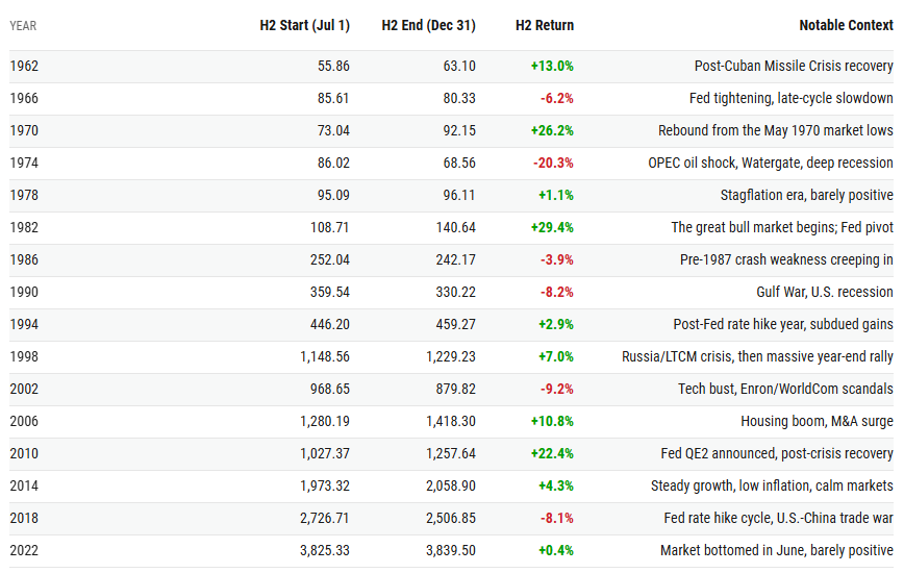
History provides a mixed, but generally positive, picture for investors during the second half of midterm election years. Since 1962, there have been 16 midterm elections. The S&P 500 posted positive second-half returns in ten of those years and negative returns in six, with an average gain of 3.85%.
The average gain during the positive years was 11.75%, while the average decline during the negative years was 9.32%. Although history has generally favored positive returns, the range of outcomes has been wide, reminding investors that midterm election years can still be volatile.
That volatility has often shown up well before year-end. The average peak-to-trough decline during the second half of these years has been roughly 12%, with the market low occurring in October in half of the historical periods. Even in years that ultimately finished higher, investors frequently experienced meaningful pullbacks along the way.
Of course, elections are only one factor influencing market performance. Economic conditions have historically mattered much more. Three of the six negative periods occurred while the US economy was already in recession (1974, 1990, and 2002). Although recession risks always exist, the current economic backdrop appears healthier than in those periods.
That leaves monetary policy as an important variable for investors today. In two of the remaining negative midterm periods, Federal Reserve tightening was a meaningful contributor to weaker market returns, making this week's meeting particularly important.
The Federal Reserve met on Wednesday and, as expected, left its target rate unchanged. While the Committee did not raise rates, its statement reinforced concerns that inflation remains above its long-term objective and that further policy tightening remains a possibility. Markets continue to expect additional rate hikes later this year.
According to the CME Group's FedWatch Tool (CME Group), there is a 60% probability that the federal funds rate will be above today's target range following the September meeting. That probability rises to 70% after the October meeting and 83% by year-end.
History suggests the second half of a midterm election year can be bumpier for investors. While election headlines are likely to dominate the news cycle over the coming months, the bigger driver of market performance will likely be how the economy and inflation respond to a potentially more restrictive Federal Reserve. As always, periods of increased uncertainty are a normal part of investing, and maintaining a long-term perspective remains the best approach.
Financial Planning Corner:
401k Catch-Up Provisions – Are You Taking Full Advantage of Your Saving Opportunities?
The second half of the year is a great time to review your 401k contributions and make any adjustments before year-end.
For 2026, you can contribute up to $24,500 to your traditional 401k, Roth 401k, or a combination of the two. If you'll be 50 or older by the end of the year, you're eligible to contribute an additional $8,000, bringing your total to $32,500. If you will be age 60 to 63 by the end of 2026, the enhanced SECURE 2.0 "super catch-up" provision allows you to contribute an additional $11,250, for a total of $35,750. Another change under SECURE 2.0 this year is that if your prior-year wages from your current employer exceeded $150,000, any catch-up contributions must be made as Roth contributions.
For business owners, the opportunity can be even greater. In addition to employee deferrals (including any eligible catch-up contributions), you may also make employer contributions, which are generally limited to 25% of eligible compensation. Combined employee and employer contributions can total up to:
- $72,000 if you are under age 50
- $80,000 if you are age 50–59 or 64+
- $83,250 if between the ages of 60-63
For a full list of retirement plan options for business owners, check out our article: RSWA Blog – Retirement Savings Options for Small Business Owners
While not everyone can or should max out their retirement plan, increasing your contribution even a little can make a meaningful difference over time. If you're unsure whether you're on pace to reach your savings goals, now is an excellent time to review your plan and make any needed adjustments before the end of the year.
Quick Hits:
- Home Price-to-Income ratios across the globe. I was surprised to see how the US stacked up Visual Capitalist
- Looking for a fun night out this summer? Check out the Prescott Park Arts Festival for live music, a musical, or a movie: Prescott Park Arts Festival
- Meet Jimothy the raccoon, accomplishing the seemingly impossible: uniting Democrats and Republicans The Times
- Start planning your fall travel plans now: USNews – Travel
New Mile World Record
For only the second time in my lifetime, and just the fourth time since 1985, the men’s mile world record has fallen. Earlier this month, Great Britain's Josh Kerr set a new world record in London, running 3:42.66. To put that into perspective, Kerr maintained a pace of more than 16 miles per hour for the entire mile.
More than 72 years ago, Roger Bannister made the mile one of track and field's most iconic events by becoming the first person to break the four-minute barrier. While the sub-four-minute mile remains a defining benchmark, advances in training, nutrition, and technology have continued to push the limits of performance.
To put that evolution in perspective, if Bannister’s historic 3:59.4 mile were run alongside Kerr’s record, he would still be roughly 112 meters behind as Kerr crossed the finish line, not yet reaching the final straightaway.
Kerr, who is known for never lacking confidence, was asked before the race what concerned him most about attempting the world record. His response: “What if it’s easy?” He certainly made it look that way. YouTube
Quote: “Time is your friend; impulse is your enemy.” - John C. Bogle
Thank you for reading RSWA Financial Advisor Insights! We welcome feedback, and please forward this to a friend! Be well, take care, and stay safe!